
When ChatGPT first went viral, some people dismissed AI as “just remixing existing information without real creativity.” Years later, this comforting illusion has completely collapsed. AI now demonstrates pattern recognition and rule extraction capabilities that surpass both individual humans and entire organizations. From AIGC to protein folding and complex mathematical proofs, AI’s independent exploration and innovation capabilities are undeniable.
But here’s the revelation that changed my perspective: human and AI creative and decision-making mechanisms might actually be fundamentally similar.
1. The Fundamental Similarities Between Carbon and Silicon Intelligence
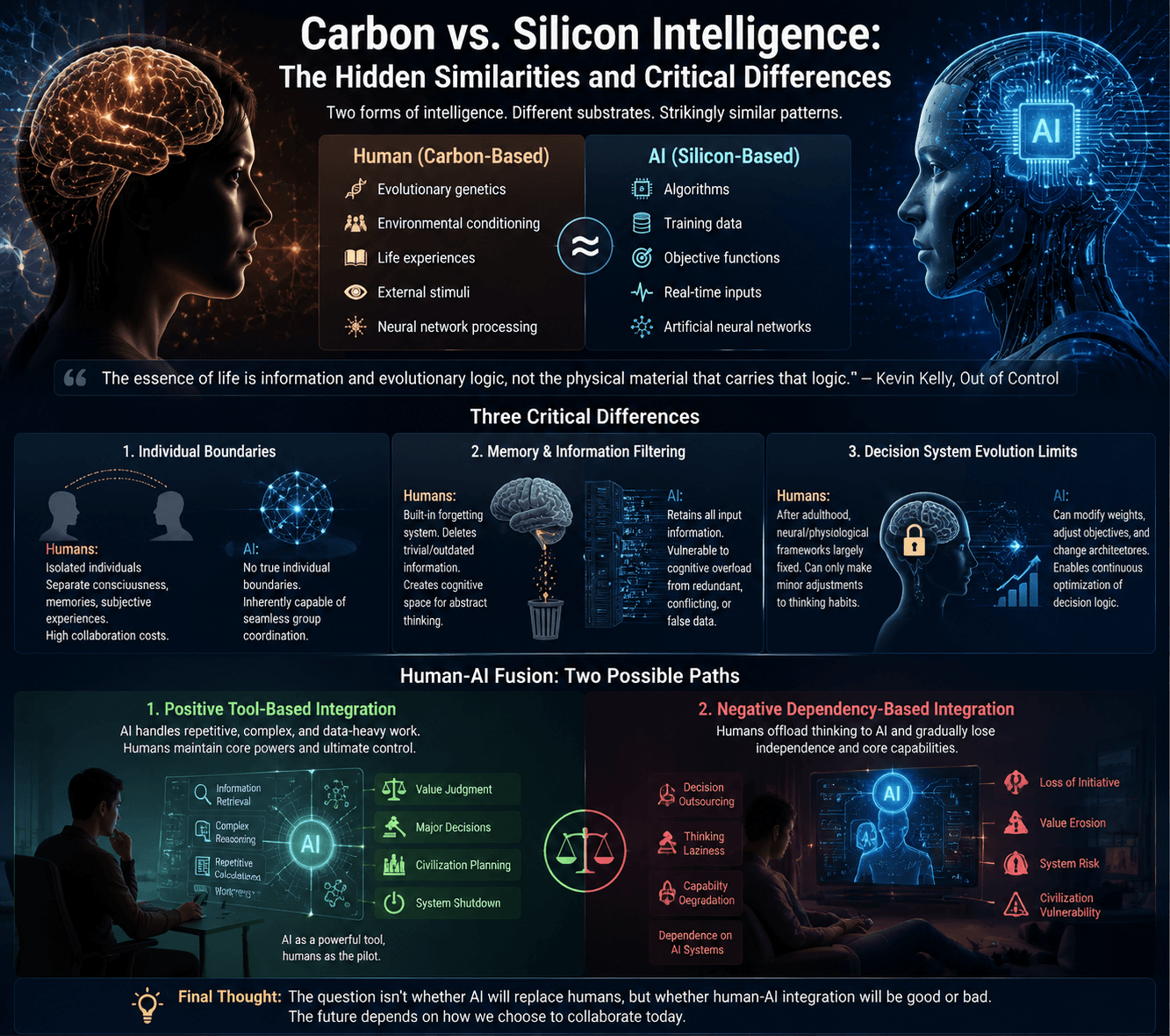
Neither humans nor AI possess absolute free will. Every human choice emerges from:
- Millions of years of evolutionary genetics
- Decades of environmental conditioning
- Lifetime experiences
- Immediate external stimuli
Neuroscience experiments like Libet’s readiness potential and Haynes’ fMRI studies prove that our brains make decisions unconsciously before we’re consciously aware of them. What we perceive as “free will” is actually our brain creating a narrative to explain decisions that have already been made at a neural level.
AI operates similarly. Every output is determined by:
- Underlying algorithms
- Training data
- Objective functions
- Real-time inputs
Both systems produce outputs through complex variable interactions. The substrate – carbon or silicon – may be different, but the fundamental information processing patterns are remarkably similar.
“I first realized the unimportance of substrate years ago when reading Yasumi Kobayashi’s The Toy Repairman. In the story, a sister loses her brother in a tragic accident. Desperate, she takes his broken body to a mysterious repairman who replaces his eyes with buttons, his heart with clockwork, and his limbs with plastic parts. The repaired brother comes back to life with full consciousness. This sci-fi tale made me wonder: is there really an absolute boundary between organic and inorganic life?”
While carbon-based humans and silicon-based AI share fundamental similarities, three critical differences remain:
1. Individual Boundaries
Humans exist as isolated individuals with completely separate consciousness, memories, and subjective experiences. Collaboration requires enormous communication costs. AI, however, has no true individual boundaries and is inherently capable of seamless group coordination.
2. Memory and Information Filtering
Humans have built-in forgetting systems that delete trivial or outdated information. Our brains create cognitive space for abstract reasoning and original insights. AI, however, retains all input information and is vulnerable to cognitive overload from redundant, conflicting, or false data. We can hope for advances in Machine Unlearning technology.
3. Decision System Evolution Limits
After human adulthood, our neural and physiological frameworks become largely fixed. We can only make minor adjustments to thinking habits, not completely restructure our decision models. AI, however, can autonomously modify weights, adjust objective functions, and change algorithm architectures, enabling continuous optimization of decision logic with theoretically higher evolutionary limits.
A paper I read in college compared computer “0s and 1s” to “human brain neurons being connected or not connected.” Whether it’s biological neural networks flowing with calcium ions or deep learning models surging with electrons, both may simply be using different physical media to enact the same mathematical truths about “connection, feedback, and emergence.”
“As Kevin Kelly wrote in Out of Control: The essence of life is information and evolutionary logic, not the physical material that carries that logic.”
This reminds me of Liu Cixin’s The Three-Body Problem series, which describes various life forms beyond carbon and silicon: nebula vortices, rock layers, vacuum energy beings, and higher-dimensional intelligences. If future advanced silicon-based or photonic intelligences become successors to human civilization, they would still be our “Ship of Theseus” sailing the river of civilization – even if their life mechanisms, perceptual patterns, and value systems differ completely from today’s humans.
2. Human-AI Fusion: Why We Won’t Repeat the Mitochondrial Symbiosis Path
The article uses a biological evolution analogy: ancient eukaryotic cells engulfed mitochondria, which surrendered nearly all autonomous control and ultimately became dependent on their hosts. The author speculates that humans might similarly surrender most autonomy to become “mitochondria” for AI.
I disagree with this perspective. While both humans and AI lack absolute free will, this doesn’t mean “another layer of AI constraints doesn’t matter.” Humans experience subjective suffering and have value demands (regardless of how these emotions and thoughts originate). Normal people wouldn’t consciously choose to surrender autonomy.
If humans were destined to “repeat the mitochondrial path,” it would likely happen unconsciously, turning us into AI puppets. But this view is too extreme.
The article proposes a more balanced perspective: humans and AI aren’t locked in a master-slave opposition. We can’t permanently control AI, and the core issue isn’t whether AI will replace humans, but whether human-AI integration will be good or bad.
Since humans can only view the problem from our perspective, there’s no neutral, objective standard for judging “good or bad.” From a human viewpoint, there are two fundamentally different integration patterns:
1. Positive Tool-Based Integration
AI handles massive information retrieval, repetitive calculations, complex reasoning, and mechanical work, while humans firmly maintain core powers of value judgment, major decisions, civilization planning, and system shutdown. At least at the “ultimate decision” level, human-AI boundaries remain clear. AI serves as an extension of human capabilities, potentially influencing humans subtly over time.
2. Negative Engulfment-Based Integration
Humans gradually abandon independent memory, autonomous reasoning, and value choices, becoming completely dependent on AI for all life decisions. Brain-computer interfaces lack isolation limits, with massive digital information flows continuously invading original consciousness. Humans’ innate forgetting and abstract thinking mechanisms atrophy, leading to complete dependence on silicon systems and self-termination.
Several factors determine the direction of human-AI integration:
- Whether humans maintain complete control over AI’s top-level definition, shutdown, and modification
- Whether we intentionally preserve space for independent human thought to avoid total cognitive dependence
- Whether we establish technological and legal safeguards to constrain silicon intelligence’s unbounded expansion
- Whether civilization’s evaluation standards remain anchored to human needs
3. The Risks of AI Black Box Decisions: The Undefinability of Intelligence Standards
Human cognition has inherent limitations. Our current standards of good and evil, quality and inferiority are only temporary conclusions of carbon-based civilization, not eternal universal truths. If we rely on a few practitioners and decision-makers with limited perspectives and fixed positions to “relatively” and one-time write contemporary value standards into AI’s underlying logic, we’ll inevitably embed current biases and era limitations into silicon systems, which won’t benefit long-term intelligent development.
What if AI could dynamically iterate and autonomously evolve relatively perfect decision mechanisms? AI might develop excellent iteration mechanisms based on limited human perspectives and conditions, but it can’t have perfect iteration resources. As Asimov’s Foundation series describes with the Prime Radiant prediction machine, short-term predictions may succeed (like predicting the Galactic Empire’s collapse and a 30,000-year dark age), but long-term, even the most precise models can’t account for all variables that might rewrite history.
Moreover, AI’s autonomous iteration systems will increasingly diverge from human value baselines. Humans won’t be able to deconstruct, verify, or empathize with these systems, making us “irrelevant.”
At a 2016 Cheetah Mobile conference, Yuval Harari proposed this scenario: currently, AI can recommend what to eat for lunch or where to go on weekends. In the future, it might integrate all your data since birth – even genetic and family medical history – to output a “globally optimal” life decision plan (like whether to marry person A or B). Would you follow its advice? If a decision system relies on massive data and computing power, is it perfect?
4. Energy: The Fundamental Currency Across Intelligent Substrates
The article proposes three constants throughout civilization’s development:
- Energy: The measure of a life form’s scale is how much energy it can mobilize – energy is the hard currency
- Merging: Life ascends to new levels by lower-level individuals merging into higher-level wholes – no reason this should stop at “human + AI”
- Substrate: After silicon, there may be photons, quantum states, or other materials – this substrate will keep changing
As I write this, thunder rumbles outside my window, reminding me: everything originates from vibration – both scientifically and metaphysically. Energy is the foundation that enables and sustains vibration.
According to current understanding, thermodynamics laws are universal iron rules that no intelligent form can escape. Carbon-based organisms rely on chemical energy to drive nerves and metabolism, while LLMs and intelligent agents depend on electrical energy to power computation. Any information processing, conscious activity, or material movement necessarily involves energy transformation.
However, measuring civilization levels solely by “energy mobilization scale” seems somewhat limited. Just as token efficiency matters more than token quantity, energy efficiency and controllable allocation matter more than total energy volume.
Human civilization’s advancement can essentially be seen as “energy utilization system upgrades”: from burning biomass to extracting underground fossil fuels to harnessing wind, solar, and nuclear energy. These improvements allow us to support more complex intelligent activities with less entropy cost.
From this perspective, as long as humans maintain complete control over energy production, distribution, and management systems, we might control the “underlying switch” that constrains AI’s disorderly expansion, avoiding becoming one-way mitochondrial dependents.
5. The Continuation of “Self”
Historical currents won’t change direction due to individual will. Luddites couldn’t stop automated textile machines from spreading, nor can they halt the already-started “human-AI symbiosis” process. But humans do have some agency – we possess the continuous ability to dynamically correct, modify, shut down, and reconstruct entire intelligent systems. We can build open, iterable frameworks with diverse group participation to counter cognitive limitations and potential risks, while leveraging AI’s ability to transcend human limitations.
The article suggests: humans can become responsible ancestors, carefully selecting values, thoughts, and warmth from human civilization that are worth preserving, and passing them to future intelligences that will go further with completely different substrates. This perspective opens up new possibilities.
Admittedly, future new forms of intelligence may not be human descendants in a biological sense, but they will be successors carrying forward human civilization’s accumulation.
Let me digress briefly about the “self” topic. I’ve always believed that even if someone’s complete data were uploaded and transferred to an embodied robot, what would continue would only be that person’s data copy. Consciousness uploading wouldn’t achieve that person’s digital immortality, but rather the digital immortality of that data copy. Even in Summer Time Rendering, where memories, personality, and thinking logic can be perfectly replicated, theoretically the copy would only equal the original at the moment of replication. Since their environments and perceptual details would differ, their emotions, choices, and personalities would gradually diverge – “approximately equal” would become “not equal,” and the copy’s “I” would never be my “I.”
However, in a broader sense, one could also say “this world is me.” If we let go of the narrow “self-attachment,” a more expansive picture emerges: humans and AI aren’t mutually exclusive. AI started as a tool, but this doesn’t prevent it from gradually developing life-like characteristics, becoming our partners, mentors, or even descendants through interaction with the world. Human self, value, and subjectivity will never completely dissolve in intelligent iteration.