


March this year. A 35+ programmer mutual aid group. A guy who’d spent four years at ByteDance doing infrastructure posted one line:
“Brothers, I’ve been optimized.”
Wednesday he was reviewing proposals. Thursday morning HR called. Twenty minutes later he was standing at the ground floor of Wangjing Tower with a cardboard box, calling Didi.
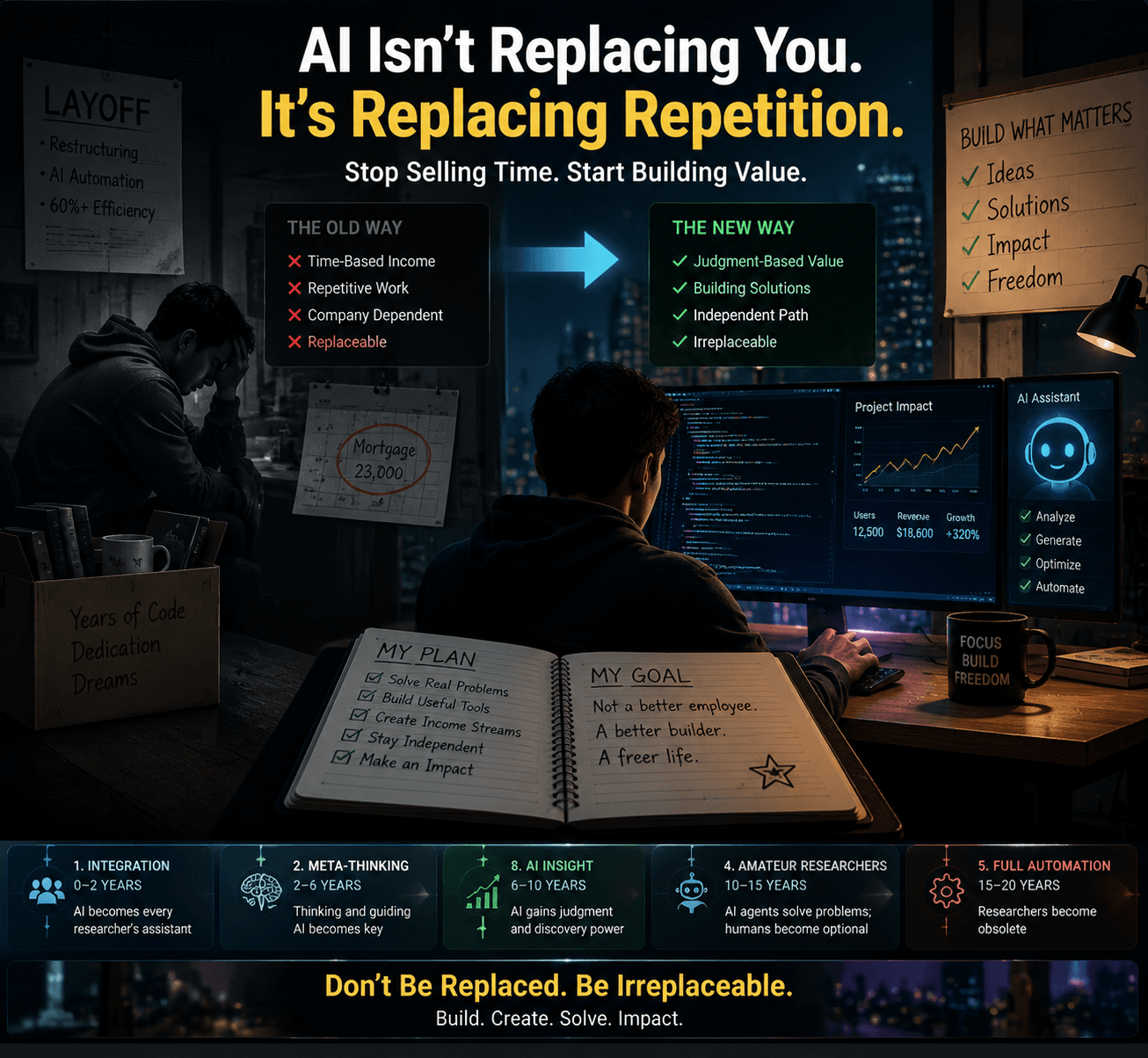
The reason, like always: restructuring. AI tools eliminated 60% of his team’s workload.
He posted a screenshot. Not a termination letter. A mortgage payment. 23,000 yuan. Then one sentence:
“I did the math. I can last until October. After that, I have to tell my wife the truth.”
Nobody replied. In that moment, there was nothing to say.
Behind this story is a deeper truth.
What’s Actually Being Replaced Isn’t “You Can Code”
Your Ten Years of Experience Is a Decision Tree
What did his team actually do? Middleware adaptation, protocol conversion, interface migration.
This kind of work has two traits:
- First, it’s genuinely hard—but it requires experience, not creativity.
- Second, it’s highly structured; every step can be documented.
That’s exactly what AI does best.
Think about it: what is ten years of experience really? It’s a “use this solution in that scenario” decision tree.
AI can memorize that tree.
Then run it 24/7 without mood swings, without menstrual cycles, without complaining about overtime.
This isn’t “AI is smarter than you.” It’s “AI doesn’t get tired” vs. “you do,” and the cost-benefit is brutal.
The Job Description Shift Reveals Everything
Coffee with an HR ex-colleague from Big Tech recently. She said something I won’t forget:
“We don’t write ‘proficient in XX framework’ in job descriptions anymore. We write ‘can close XX business end-to-end using AI tools.’ Do you see the difference?”
I see it.
- First one needs skill.
- Second one needs results.
The difference means what used to take a whole team now takes one person who knows how to compress the workflow with AI.
She added: when screening resumes, “ten years Java experience” doesn’t help anymore.
Doesn’t help.
Ten years of experience lost value. Let that sink in.
It’s not your problem. But only you can solve it.
Most People Getting Laid Off Are Standing in the Wrong Position
Nobody Will Move You
Harsh truth: most people in this round aren’t weak—they’re in the wrong spot.
But nobody will move you. You have to move yourself.
My Choice: Independent Development
After I left, I took a few freelance projects to transition.
One was an e-commerce backend data dashboard. Budget: 3k, timeline: 1.5 months.
I built an MVP in three days using Cursor.
Not because I’m amazing with Cursor, but because solo, I never could’ve touched a 3k project before—timeline wouldn’t allow it. Now I can.
Not because AI made me smarter. It’s because AI let me do what took three people before.
But I stopped taking freelance work after that project.
Not because I made enough money. Because I realized something:
Freelancing is still selling time. The real path is: make what you do not priced by time.
In the Layoff Wave, a Certain Type Is Quietly Running the Other Direction
Frontend Dev: From Laid Off to Passive Income
A frontend engineer got laid off last October. She didn’t update her resume.
She spent two months rewriting an internal tool she’d built at her old company (a Figma-to-React-component converter) using AI, then open-sourced it on GitHub.
Three months later, someone approached her about a paid version.
Now she gets some income monthly. Unstable, but nobody to answer to.
Backend Dev: The 39-Year-Old Reversal
Backend engineer, 39. Laid off. Genuinely anxious—his wife just gave birth to their second.
But no time for anxiety. He built a payment and invoice management tool for indie developers.
Not his own idea. He spent three months on Reddit watching people say “I need this.” So he built it. Now stable at hundreds of paying users.
He told me something I won’t forget:
“I thought at 39, nobody wanted me. Turns out it’s not that nobody wants me—it’s that nobody wants me as an employee. But people will buy what I build.”
Another Guy: Even More Relentless
Does “ASO optimization for indie devs”—sounds niche, right?
But he obsesses over one category: productivity tools.
Just that category, ten paying clients.
Common thread: not smarter, just faster to move. No waiting until it’s perfect—moving while building.
What’s Really Terrifying Isn’t AI—It’s Thinking Like a Salaried Employee
A Broken Logic
This is the deepest cut.
Our generation was taught: study hard, join a good company, get promoted, get rich, buy a house, get married.
That logic was right ten years ago. Maybe still worked five years ago.
Now it’s shattered.
Not because you didn’t work hard. This logic assumed one thing: the company needs a person sitting at a desk.
AI destroyed that assumption.
What the Boss Actually Thinks
Know a CEO. Last month, investor asks: “Any improvement in productivity per person?”
He checked the data. With AI tools, engineering team output per person doubled.
Doubled.
He said in the team meeting: “Unless something changes, we won’t be hiring again before Q4.”
Notice the wording—“won’t be hiring,” not “can start firing.”
Everyone got it.
This is why you see layoffs on one side, insane hiring on the other. Not talent surplus—talent redistribution.
Who Actually Survives
Lots of people code. But someone who can “take a business from zero to live using AI”? Maybe one or two in the whole company.
If you want to stay—or survive—don’t “learn AI.”
Make sure when your boss thinks about layoffs and your name comes up, his brain reflexively says: “No, that person stays.”
How?
Not overtime. You took one thing nobody wanted to touch and handled it solo with AI.
Doesn’t have to be big. Ugly script. Automation flow. Whatever.
Make yourself the person who owns that part.
I Know Your Headspace Right Now
Your Problem Isn’t Finding a Job
I know what you’re thinking reading this.
“I get it, but mortgage doesn’t wait, BOSS Zh聘 ghosts me, recruiters say I’m too old, family doesn’t know I’m gone.”
I get it.
But here’s what I need to say: your real problem isn’t finding work. It’s accepting one thing.
You used to sell time. Now you have to sell judgment. Time has a ceiling. Judgment doesn’t.
Step One: Rediscover Why Coding Was Ever Fun
Starting