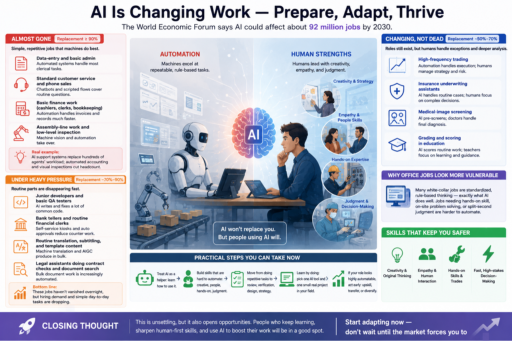
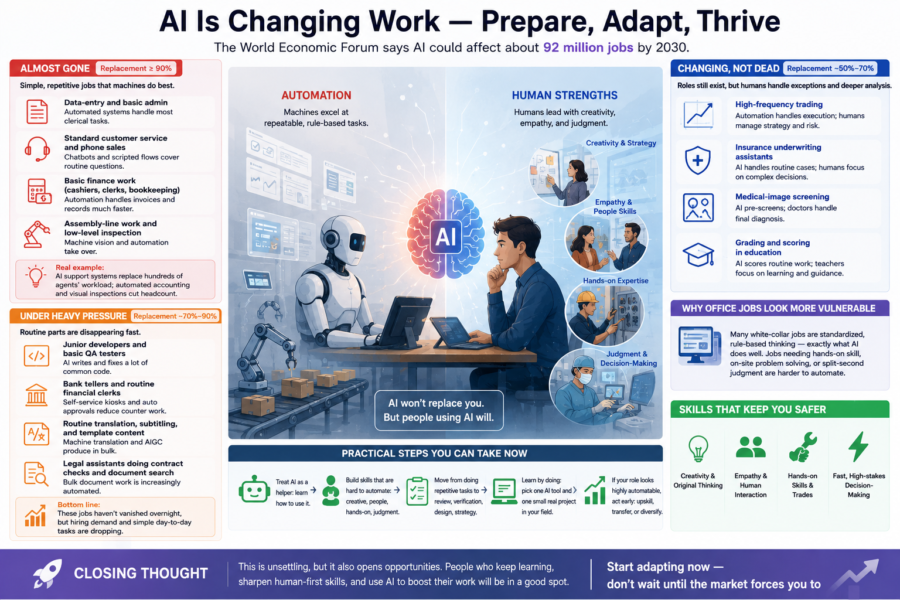

The World Economic Forum says AI could affect about 92 million jobs by 2030. In short: “machines replacing people” is already real. Jobs that used to feel safe are changing fast. I list what’s already being replaced, what’s under heavy pressure, and what’s shifting — plus practical tips so you can prepare.
Almost gone (replacement ≥ 90%)
These jobs are repetitive and rule-driven — perfect for automation. Examples:
Data entry and basic admin: many small businesses no longer hire pure clerical staff; a few people just manage the automation.
Standard customer service and tele-sales: chatbots and automated flows answer routine questions now.
Basic finance roles (cashiers, clerks, bookkeeping): smart accounting systems handle invoices and records much faster.
Assembly-line and low-level quality checks: machine vision and automation cut these jobs a lot.
Quick real-world note: some AI customer systems can replace hundreds of agents. Automated accounting and visual inspection are already common, so layoffs or fewer hires are becoming normal.
Under heavy pressure (replacement ~70%–90%)
These used to be “stable” white-collar roles, but automation is eating their simpler tasks:
Junior developers and basic QA testers: AI writes and patches common code snippets, so entry-level work has shrunk.
Bank tellers and routine financial clerks: smart kiosks and automated approvals reduce counter work.
Routine translators, subtitlers, and template content creators: machine translation and AIGC churn out basic content fast.
Legal assistants doing contract checks and document search: AI handles bulk document work.
Short take: these jobs haven’t vanished overnight, but hiring and simple on-the-job tasks are steadily shrinking.
Changing, not gone (replacement ~50%–70%)
These roles remain but are being reshaped and demand higher skills:
High-frequency trading, insurance underwriting assistants, medical image screeners, grading and scoring in education — AI automates a lot of the routine parts, leaving humans for exceptions and deeper analysis.
If you stay in these roles without upskilling, your job will change into supervision or may shrink.
Why many white-collar jobs are at risk
It’s uncomfortable but true: a lot of office work is standardized cognitive labor, which AI does well. Jobs needing hands-on skill, on-site problem solving, or split-second judgment are harder to fully automate right now.
Skills that are safer (your protective moat)
Focus on abilities AI can’t easily copy:
Original creativity (top creatives, strategy leads)
Deep human skills and empathy (therapists, senior teachers, negotiators)
Skilled manual work and on-site trades (experienced electricians, chefs, craftsmen)
Real-time, high-stakes decisions (surgeons, firefighters, police)
Practical steps you can take now
Treat AI as a tool: learn to use it to get more done, not as a threat.
Build non-automatable skills: creativity, people skills, hands-on ability, and judgment.
Move from “doing routine work” to roles like oversight, verification, design, or strategy.
Learn by building: pick an AI tool and a small, practical project in your field.
If your role is highly automatable, act early: train, seek internal transfers, or start side projects to diversify income.
Final note:
Yes, this is worrying — but it’s also a chance. People who keep learning, strengthen uniquely human skills, and use AI to amplify their work will find new opportunities. Adapt early; don’t wait until the job market forces you to.