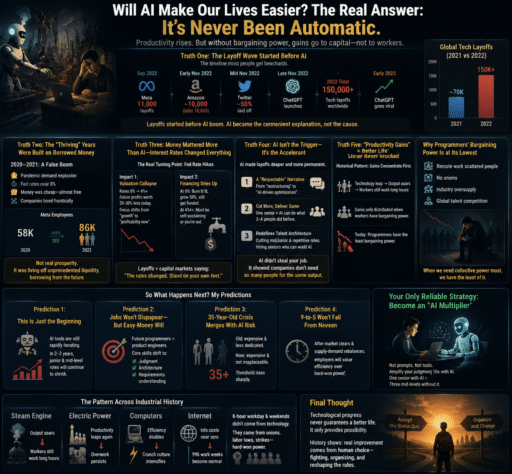

This question hides a common misconception:
“Productivity rises → Less work → Life gets easier”
The logic sounds perfect. But look through industrial history since the 1700s, and this equation has never automatically worked.
Technological progress never voluntarily shares gains with workers. It first concentrates benefits with capital, and only distributes them when workers gain enough bargaining power.
Right now, programmers have the least bargaining power for exactly this moment.
Truth One: The Layoff Wave Started Before AI
The timeline most people get backwards
Many think ChatGPT’s 2023 boom caused programmer layoffs.
Actually:
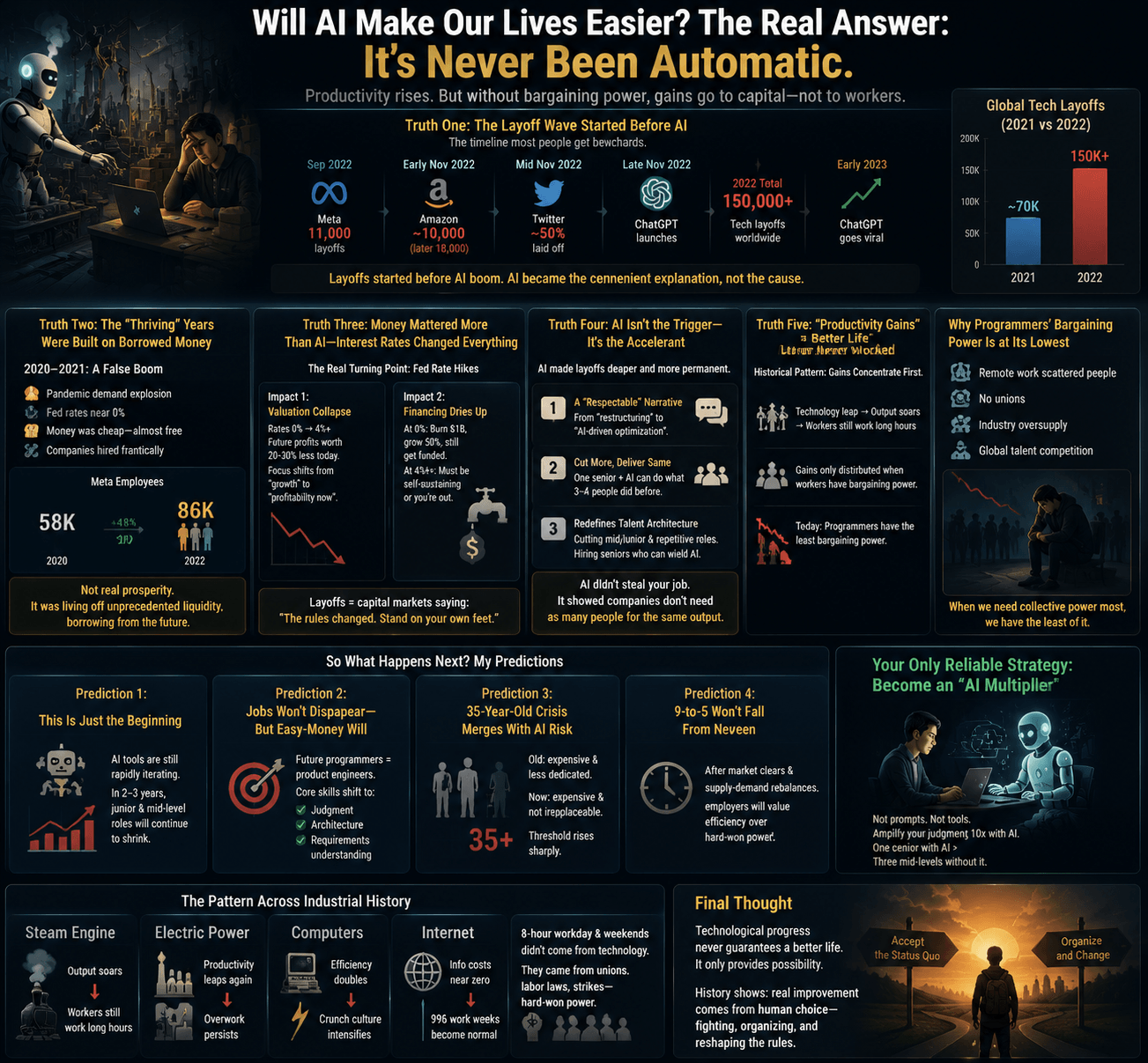
- September 2022: Meta announces 11,000 layoffs
- November early 2022: Amazon announces ~10,000 layoffs (later expanded to 18,000)
- November mid 2022: Twitter laid off ~50% after acquisition
- November late 2022: ChatGPT launches
Global tech industry laid off over 150,000 people in 2022 alone—multiple times the 2021 rate.
ChatGPT became “trendy” only in early 2023.
So the cause-effect chain “AI develops → programmers get laid off” is chronologically backwards.
More accurately: Layoffs started before AI took off. AI is the tool that was conveniently picked up afterwards to justify those cuts—not the spark that lit the fuse.
Truth Two: That Period When Companies “Thrived” Was Built on Borrowed Money
2020-2021 was a false boom
Some ask: “Companies were fine keeping all those people before. Why can’t they now?”
This question contains the biggest blind spot.
What happened in 2020-2021?
- Online demand exploded during pandemic
- Federal Reserve dropped rates to near 0%
- Money was cheap—almost free—and VCs and big companies hired frantically
Concrete numbers:
- Meta had ~58,000 employees in 2020
- Meta had ~86,000 employees in 2022
- Nearly 50% growth in just over two years
Global tech giants added hundreds of thousands of jobs, often with a “stockpile first, figure out later” mentality.
Zuckerberg later admitted that pandemic-era over-hiring was a “misjudgment.”
That “thriving” period wasn’t truly thriving.
It was living off unprecedented liquidity, borrowing from the future.
When the tide went out, it turned out many of these positions were built on sand, not rock.
Truth Three: Money Mattered More Than AI—Interest Rates Changed Everything
The real turning point: US Federal Reserve rate hikes
In 2022, the Federal Reserve raised the baseline rate from near 0% to 4%+ in a single year.
The damage to tech companies was devastating. Two mechanisms at work:
Impact One: Valuation Model Collapse
Tech company valuations—especially unprofitable ones—are fundamentally about discounting future cash flows.
When rates jump from 0% to 4%+, that future profit is worth 20-30% less today.
Stock prices crashed. Investor focus shifted from “growth at all costs” to “profitability now.”
Suddenly CEO KPIs changed overnight from “land-grab” to “cost-cutting.”
The fastest way to cut costs? Layoffs.
Personnel is tech’s largest single cost line—often 50%+ of total spend.
Impact Two: Financing Dries Up
At 0% rates, even a company burning $1 billion yearly could raise funds if growing 50%.
At 4%+ rates, investors ask: “Can this business actually generate its own cash flow? If not, we’re out.”
The 2022-2023 layoff wave was essentially capital markets telling tech:
“The game rules changed. From today on, you need to stand on your own two feet and self-fund.”
In this entire story, AI has been a supporting actor—not the protagonist.
Truth Four: AI Isn’t the Trigger—It’s the Accelerant
AI did three things that made layoffs deeper and more permanent
AI didn’t cause the crisis. But it did three things that made it more severe and harder to reverse:
Thing One: Provided a “Respectable” Narrative
“Strategic restructuring” sounds cold.
But “We’re reimagining our engineering processes with AI and optimizing team structure” sounds progressive.
Every mass layoff needs a story to tell externally.
AI is the perfect story. It plays well to employees, investors, and media alike.
Thing Two: Made “Cut 50%, Still Deliver” Possible
Before: Cut 30%, product quality likely suffers.
Now? One senior engineer with AI-assisted coding, testing, and review tools can handle what used to require three-to-four people.
Management now has real confidence: cut deeper, it won’t break.
Thing Three: Redefined “Talent Architecture”
AI makes the strong stronger, and exposes which roles are replaceable.
So we see a new pattern:
- Cutting mid and junior + repetitive roles
- Hiring senior roles that can wield AI
Cutting and hiring simultaneously. Total volume shrinks, structure shifts.
On job boards, “AI Engineer” roles grow while “Junior Frontend” roles decline.
In one sentence: AI didn’t steal your job. AI revealed that companies don’t actually need as many people to maintain the same output.
Truth Five: “Productivity Gains = Better Life”—This Logic Never Worked in History
This is the deepest layer of the original question
“Machines can work now, so people should have it easier?”
Nineteenth-century workers thought the same thing.
The Luddite Lesson
1811: The Luddite movement. Textile workers smashed machines, believing machines were the enemy.
The machines won.
But the story didn’t end there.
Textile workers’ hours did drop from 14/day to 8/day. Conditions did improve.
But not from kindness. It came from organizing, legislation, strikes—workers fighting hard to negotiate.
The Pattern Across Industrial History
Look through all major productivity revolutions:
- Steam engine → Output soars → Workers still labor long hours
- Electric power → Productivity leaps again → Overwork persists
- Computers → Office efficiency doubles → Crunch culture intensifies
- Internet → Information costs near zero → 996 work weeks become normal
No major leap in productivity ever automatically brought “9-to-5 weekends.”
The 8-hour workday and weekends came from unions, labor law, and workers’ hard-won voting and strike power—not from technology itself.
Technological progress never voluntarily distributes gains to workers. It concentrates them first. Only when workers gain bargaining power does distribution happen.
This Is the Weakest Bargaining Moment
Why programmers specifically lack leverage right now
Programmers’ challenge isn’t the technology. It’s the group’s negotiating power collapsing:
- Remote work scattered people — No office = no physical gathering = no solidarity
- No unions — One voice is easily dismissed
- Industry oversupply — Too many competitors willing to undercut
- Global talent competition — International mobility shattered local protection
The cruelest irony: when workers most need collective power, they have the least of it.
So What Happens Next? My Predictions
Prediction One: This Is Just the Beginning
AI tools are still iterating rapidly. In 2-3 years, junior and mid-level programmer roles will continue compressing.
This isn’t speculation. It’s already happening.
Prediction Two: Programming Won’t Disappear—But the Easy-Money Window Will
The job title won’t vanish.
What disappears is the era of “I can code loops and make good money.”
Future programmers will resemble product engineers more. Core skills shift to:
- Judgment — knowing which tools solve which problems
- Architecture — designing maintainable systems
- Requirements understanding — turning fuzzy needs into clarity
Prediction Three: The 35-Year-Old Crisis Merges With AI Risk
The old 35-crisis was “expensive and less dedicated.”
Now it’s “expensive and not irreplaceable.”
Combined, the threshold rises sharply.
Young professionals should decide early: are you chasing this job’s salary, or its irreplaceability?
Prediction Four: 9-to-5 Won’t Fall From Heaven
If programmers want 9-to-5, there’s only one path: after the market clears, supply and demand rebalance, and talent becomes genuinely scarce again, employers will shift from “maximize hours worked” to “maximize hours’ efficiency.”
That’s a market cycle issue, not an AI issue.
On the individual level, the only reliable strategy is becoming an **”AI multiplier.”**
Not learning prompts. Learning to amplify your own judgment tenfold with AI.
One senior who uses AI can replace three mid-level developers who don’t.
Be the multiplier. Don’t be the one getting multiplied away.
You can check out beyazkuleinsaat
Final Thought
This era offers us one cruel but honest truth:
Technological progress itself never guarantees better lives. It only provides possibility.
History shows us the real improvement comes from human choice—choosing to fight, organize, reshape the rules of the game.
Right now, that choice rests in each person’s hands.