
I hesitate to say this. It’s not disrespecting clients. It’s the deepest insight from three years of building enterprise AI projects.
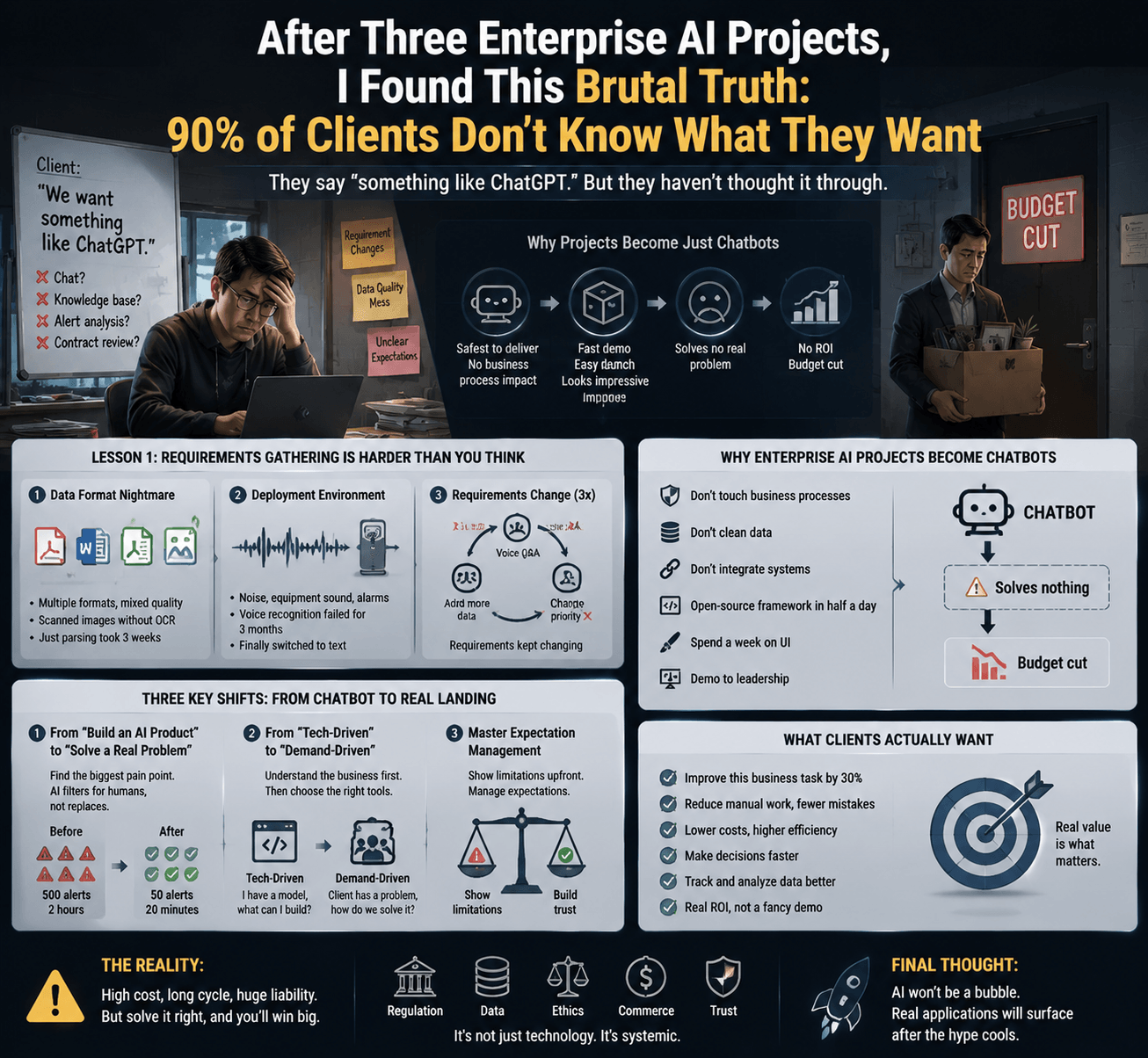
Ask a client “what do you want to use AI for?” Nine out of ten say: “Something like ChatGPT.”
But what does “like ChatGPT” mean?
- Chat?
- Knowledge base?
- Alert analysis?
- Contract review?
They haven’t thought it through.
This is why everything becomes a chatbot—it’s the simplest deliverable. Fast demo, fast launch, easy presentation. Then what? Two months in, nothing useful except weather chat and weekly report writing. Leadership sees ROI, cuts budget.
I’ve been through this many times. Here are my real pit experiences.
Lesson One: Requirements Gathering is Harder Than You Think
The “Intelligent Q&A System” in Power Utilities
We did AI implementation in power utilities. First project: client wanted an “intelligent Q&A system.”
Sounds clear, right?
Not at all.
“Intelligent Q&A” can mean ten completely different systems:
- FAQ bot: Ask once, get one answer from preset pairs. Simplest, half day to launch.
- Knowledge base retrieval: Ingest documents, answer user questions from docs. Our direction.
- Rule engine: Smart judgment based on business rules.
- NLU: Understand complex semantics.
We chose knowledge base retrieval. From requirement to launch: six months.
Not because the tech was hard. Because the client changed requirements three times.
First Requirement Change: Data Format Nightmare
Client said “put all documents in.”
We loaded dispatch procedures, relay protection manuals, network operation specs, equipment guides, maintenance reports.
Then discovered—format chaos. PDFs, Word, scanned images, Excel. Scanned images without OCR text layers.
Just parsing these into usable text took three weeks.
Client didn’t understand: “Isn’t it just file upload? Why so slow?”
My first lesson: when doing requirements with clients, first step isn’t discussing features. It’s having them send all documents for review.
Then say what’s possible and what isn’t.
Second Requirement Change: Deployment Environment
Knowledge base built, testing phase: client suddenly says “we also need voice Q&A.”
Text isn’t enough. Need a device in the duty room. Operators ask by voice, system answers by voice.
Not hard technically. Add speech recognition and synthesis.
But the environment. Power station duty room: equipment noise, AC noise, occasional alarms.
Speech recognition accuracy is terrible here. Tried three months. Finally, client said forget it, use text.
This taught me: clarify usage scenarios in requirements.
Not “what features do you want” but “who, in what environment, on what device, how will they use it.”
Miss one detail, your entire technical plan collapses.
Why Enterprise AI Projects Become Chatbots
Chatbots Are the “Safest” Deliverable
Chatbots are actually the safest output. Why?
Because they don’t touch business processes.
Build contract review agent: Understand contract approval flow. Which clauses must check? Which are risky? Who reviews, who approves, who’s liable? Business understanding, not tech.
Build knowledge base Q&A: Fix data quality first. Client documents are messy, versions duplicate, content outdated. Data cleaning takes longer than system building. And it’s never one-time—documents continuously update, KB needs maintenance. Client won’t invest people, AI team can’t manage it. Everything rots. You can check out beyazkuleinsaat
Build smart monitoring: Connect multiple data sources. Cameras, sensors, API endpoints—each different. Many legacy enterprises have no APIs. Data comes via screenshots or manual export.
So chatbots become default:
- Don’t touch business flows
- Don’t clean data
- Don’t integrate systems
- Open-source framework in half day
- Spend a week on UI
- Demo to leadership
But chatbots solve nothing. Leadership doesn’t want “chat with AI.” They want “improve this business task by 30%.”
Three Key Shifts: From Chatbot to Real Landing
Shift One: From “Build an AI Product” to “Solve a Real Problem”
Initially we thought product-first: build a platform with chat, knowledge base, data analysis—do everything.
Result: doing everything means doing nothing well. Client stops using after two weeks.
We shifted: don’t build platforms, solve one problem.
Find client’s biggest pain point, use AI to improve that one process.
We chose “alert analysis.”
Power systems generate massive alerts daily. Operators see hundreds, must judge which need action, which ignore. High repetition, high cost of error. Natural AI use case.
Key insight: AI doesn’t replace humans, it filters for humans.
Operators previously: 500 alerts took two hours. Now: AI pre-sorts alerts, flags 50 for human review. Operators see only those 50.
Two hours becomes 20 minutes.
Client feels this directly.
Shift Two: From “Tech-Driven” to “Demand-Driven”
Tech-driven: “I have a model, what can I build?”
Demand-driven: “Client has a problem, what tools solve it?”
Completely opposite order.
Tech teams build gorgeous RAG, deploy models, craft UI, then pitch: “See how amazing.” Client responds: “How does this help me?”
Demand teams first understand business: how alerts generate, who handles them, what’s the process, where’s pain.
Then design solutions. Maybe final tech is just NLP classification and text summarization. Don’t even need LLMs.
But solve real problems.
Shift Three: Master Expectation Management
Hardest shift.
Client expectations often come from hype. “AI replaces 80% of work” “LLMs know everything.”
You explain “models handle text, can’t directly operate your ERP,” they don’t listen.
We learned: in demos, deliberately show errors.
Show clients AI has limits, boundaries.
Then at launch when results aren’t perfect, client already expects it. Won’t reject the whole project.
This sounds like lowering expectations. Yes. Enterprise AI’s biggest enemy isn’t tech—it’s expectation management.
High client expectations = your delivery always falls short. Lower expectations to realistic levels, your delivery exceeds them.
Real Project Pit Stories
Policy Compliance Q&A: Three Pits
Last year: policy compliance Q&A. Sounds simple—ingest policy documents, answer employee questions.
Actually, many pits.
Pit One: PDF Parsing Hell
Client’s policies all PDF—not clean Word-exported. Scanned images. Watermarked. Tables embedded as images. Headers footers full of logos.
Standard PDF parser outputs gibberish and missing text.
Used PaddleOCR. Accuracy okay, but formatting lost. Tables become scattered text. Hierarchy gone. “Safety Production Rules” becomes incoherent sentences.
Right here I knew: project success depends on data, not models.
Bad data = bad output regardless of model. Spent two full weeks on data cleaning and structure before building KB.
Pit Two: Query Rewriting Critical
User questions vastly differ from document language.
Document: “Emergency measures when transformer oil temperature anomalously rises.”
User: “Transformer hot, what do?”
Pure keyword search won’t match.
Added query rewriting—LLM converts casual user questions into formal search queries.
Recall improved ~20%.
Pit Three: Launch—Nobody Uses It
System launches. Client trains twice, distributes manual.
One month: fewer than 10 daily uses. 600-person org, under 10 people/day.
Investigated: people don’t know when to use it.
When facing policy questions at work, first instinct: ask colleagues or boss, not ask AI.
System quality is irrelevant. It’s habit. Changing work habits is enterprise IT’s biggest challenge.
We added: embed AI in OA approval workflows.
When employees submit approval requests, system auto-shows relevant policy clauses.
Don’t need employee to ask AI. AI proactively appears when needed.
Daily usage jumped 5x.AI landing isn’t “build good system, wait for users.” It’s “find workflows where AI can proactively intervene.”
AI Project Difficulty Tiers
Easiest: FAQ, Document Retrieval
Mature tech, many open-source solutions. Main work is data cleaning. Build well and it works, build poorly and you survive. Low risk, good first AI project.
Medium: Contract Review, Report Generation, Data Extraction
Needs business rule understanding, high customization. Can’t rely entirely on LLMs, need rule engines for fallback.
Common mistake: use LLMs for everything. Reality: 80% of review work uses rules, 20% needs models.
Hard: Smart Monitoring, Auto Operations, Multi-System Coordination
Multiple data sources, complex business flows, auto-handling not just alerts. Low success rate. Advise clients: “decision support” not “fully autonomous.”
Don’t Touch: Safety, Legal Compliance, HR Decisions
Model error responsibility unclear. One accident kills the project. Wait for regulations first.
Post-Delivery Maintenance Costs—Severely Underestimated
Who Maintains?
Clients count development cost, ignore maintenance.
KBs need updates, model performance needs monitoring, user feedback needs handling. Who does this?
Usually nobody.
Dev team delivers and leaves. Client has no dedicated AI ops. Three months later: stale data, declining performance, users complain “AI broken.”
Feedback Loops Rarely Execute
We add feedback mechanisms—users flag bad answers, system logs them. Weekly review, update KB.
Honest? Rarely happens. Client staff too busy, won’t cooperate.
Back to organizational issues. AI landing isn’t just tech—it’s organizational change.
Needs dedicated team managing, maintaining, iterating AI. Without it, best tech fails.
Five Lessons for Enterprise AI Builders
One: Spend Days On-Site, Don’t Just Hear Pitches
For requirements, go to client location for days.
Not conference room PPTs. Go to actual workflows.
Then you know where AI should intervene, not where to outsource.
Two: Launch Simplest Version First
First version can be rough, show AI solves something.
Iterate fast based on feedback.
Better than three months perfecting then discovering wrong direction.
Three: Price Data Cleaning and Maintenance
Many quote only dev costs, skip data cleaning or undercount it.
Then either lose money or quality suffers.
Data cleaning is 30% of cost, maintenance 20%. Can’t skip.
Four: Learn to Say No
Some requests can’t be done or cost too much.
Say boundaries upfront instead of failing. Client actually trusts you more.
Five: Select Clients by Two Metrics
One: dedicated team to work with you.
Two: leadership truly values AI, not just trends.
Missing both? Project becomes disaster in three months.
We now only take projects with clear pain, partnering team, leadership involvement.
Reject others. Fewer projects, higher success rate. Better reputation, more clients.
Final Thoughts
Enterprise AI, 2026, still early stages.
Not because tech fails. Because requirements unclear, expectations high, maintenance trails.
Fix these three, landing isn’t hard.
Don’t fix them, everything becomes chatbots.
Saved as a favorite, I like your web site!
I know this if off topic but I’m looking into starting my own blog and was curious what
all is required to get setup? I’m assuming having a blog
like yours would cost a pretty penny? I’m not very internet savvy so I’m not 100%
certain. Any recommendations or advice would be greatly appreciated.
Thank you