
I’ve heard this question too many times.
AI has been hot for years. Large language models have been iterated countless times. The government is pushing AI applications hard. Yet here we are—our lives are exactly the same. Clinics still work manually. Homes still don’t have real AI assistants. Restaurants still rely on people.
Why isn’t there large-scale AI adoption in real-life scenarios?
Everyone asks this. Few answer honestly. Let me try.
First, Two Perfect Examples—That Should Already Exist
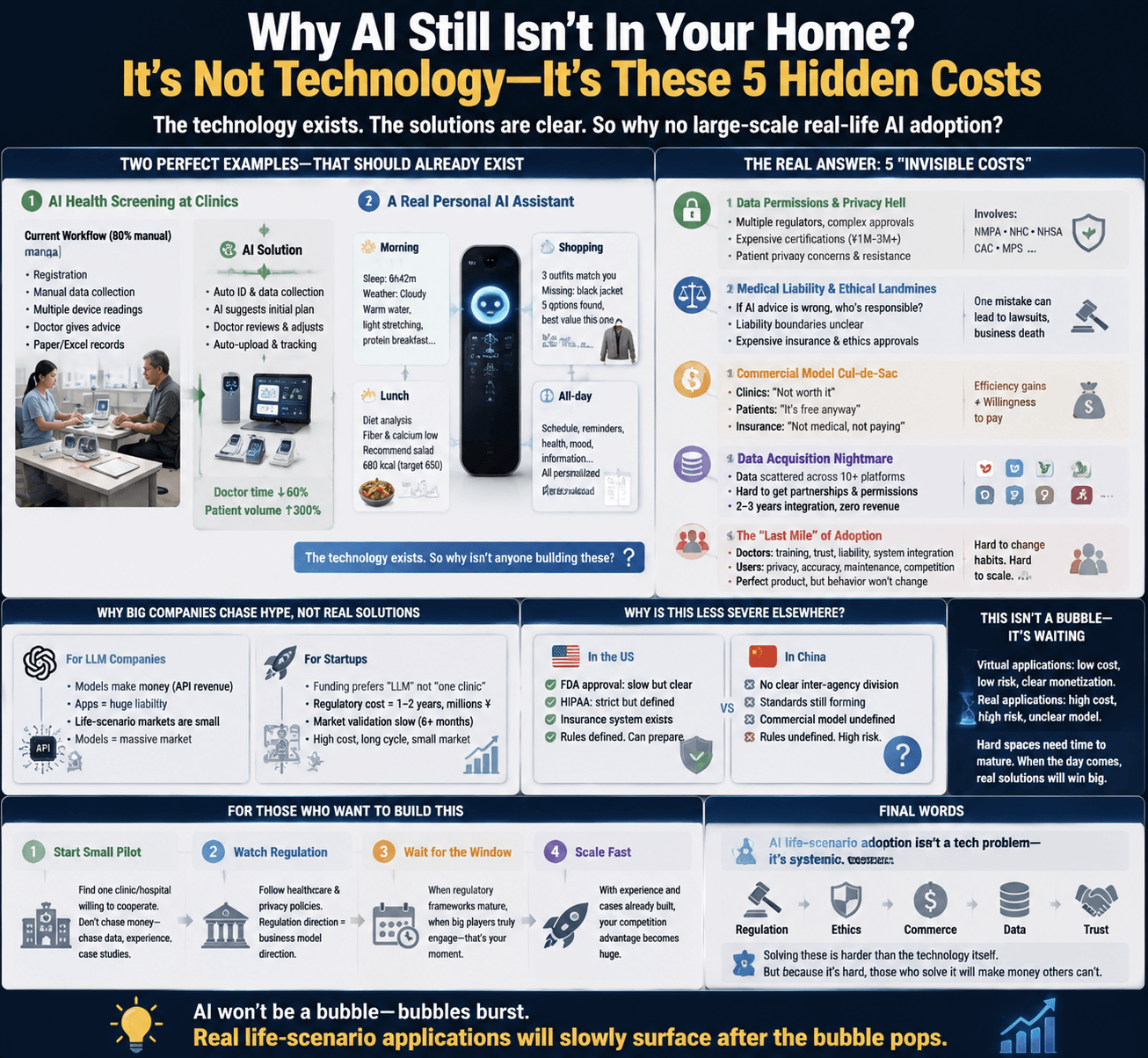
Example One: Automated Health Screening at Clinics
My friend runs a clinic. Monthly health screenings for residents. Chronic disease patients come every two weeks.
The current workflow?
- Registration, info collection (handwritten or manual input)
- Vital signs measurement—BP, glucose, weight (multiple devices, manual logging)
- Doctor analyzes and gives advice (repetitive, same for each patient)
- Archive recommendations, follow up (scattered papers or bad spreadsheets)
80% of time goes to “info gathering and organizing.” Only 20% is actual medical judgment.
What if there was intelligent hardware and software?
- Auto-identify patient (ID card, facial recognition)
- Auto-read vital signs (smart BP cuff, glucose meter, scale)
- AI suggests initial plan (based on history, regional data, latest guidelines)
- Doctor only “reviews and adjusts” the suggestion
- Auto-upload to system for long-term tracking
Doctor’s time cut by 60%. Patient volume increases 300%. The tech completely exists to do this.
Example Two: A Real Personal AI Assistant
Xiaoice AI already responds quickly. Siri, Google Assistant understand natural language.
So why isn’t there a device working like this?
Morning:“Based on last night’s sleep (6h42m, medium quality) and today’s weather (cloudy, medium UV), I suggest: warm water, 15min light stretching, high-protein low-fat breakfast. The coffee shop downstairs has a protein smoothie special today. Also, your neck fatigue is rising—try the office neck release routine this afternoon.”
Lunch:“Your diet this week lacks fiber and calcium. Three restaurants nearby; I recommend XX’s salad with yogurt. You mentioned wanting to lose weight last week—this meal is 680 kcal, your target was 650.”
Shopping:“Based on your body type, skin tone, style, and today’s weather, these three clothes suit you best. Your closet is missing a black jacket. I found five options—this one has the best value.”
This device’s tech completely exists too.
So why isn’t anyone building these?
The Real Answer: It’s Not Technology—It’s These 5 “Invisible Costs”
Cost One: Data Permissions and Privacy Hell
Great idea for clinic AI. But problem:
Who owns patient health data?
This isn’t trivial. In China, health data involves multiple regulators:
- NMPA (medical device approval)
- NHC (medical data standards)
- NHSA (medical insurance data)
- CAC (data security and privacy)
- MPS (information security)
To build this, you need:
- Medical device registration (1-2 years per device)
- Information security certification (¥200K-500K)
- Privacy policy and data processing agreements (lawyer review)
- Medical insurance system integration (different per region)
- Patient consent forms (legal requirement)
Just approvals cost ¥1-3M. Project hasn’t earned a penny yet.
Worse, patients may refuse anyway.
“My health data analyzed by AI? Stored in the cloud? What if it leaks?”
Most people think this way. No matter how smart your AI, this psychological barrier is hard to cross.
Cost Two: Medical Liability and Ethical Landmines
What if the AI’s screening advice is wrong?
Say AI says “your BP is slightly high, no urgent medication needed.” Patient trusts it. Three months later—stroke.
Who’s responsible?
- Clinic? “Doctor should have reviewed more carefully.”
- AI company? “We’re only assisting, not diagnosing.”
- Patient? “I voluntarily assumed the risk…”—but law usually sides with patient.
“Liability boundary unclear”—fatal in healthcare.
Any medical AI needs:
- Clear legal liability definition (takes multiple lawsuits to establish)
- Medical malpractice insurance (expensive)
- Ethics committee approval (many regions don’t have this)
- Continuous regulatory oversight (endless inspections)
Healthcare AI startups often don’t survive Series C.
Cost Three: The Commercial Model Cul-de-Sac
Solve the first two. Now—how do you make money?
Clinic AI—clinics get interested. Then ask:
“How much?”
You: “¥500K upfront, ¥5K monthly.”
Clinic: “That’s ¥1.1M yearly. What’s the ROI?”
You: “You cover more patients, improve efficiency…”
Clinic: “But my patient volume is fixed. I don’t want to expand—I want less doctor burden.”
This is key: B2B2C healthcare services rarely monetize via “efficiency gains.”
Because clinic/hospital volume isn’t supply-limited—it’s demand-limited. Make doctors 3x more efficient, they still see 30 patients/day because that’s all who come. So who pays?
- Charge the clinic? “Not worth it.”
- Charge patients? “I always got free registration.”
- Charge insurance? “This is medical, not value-add.”
All three refuse. Project dies.
Cost Four: Data Acquisition is a Nightmare
That AI assistant example? Perfect on paper. But:
Where does AI get the data?
For personalized advice, AI needs:
- Sleep data (smartwatch or phone)
- Weight, body fat (smart scale)
- Heart rate, BP (band or watch)
- Diet records (you log it or restaurant data)
- Exercise data (activity band)
- Location (phone GPS)
- Shopping habits (e-commerce data)
- Wardrobe data (photo + tags for all clothes)
Reality? This data is scattered, siloed, disconnected.
- Sleep: Mi Fit, Huawei, Apple Watch apps
- Weight: CloudCare, FITBIT clouds
- Exercise: WeChat Steps, Keep, Strava
- Shopping: Taobao, Douyin, Little Red Book
- Restaurants: Dianping, Meituan, Amap
To build this, you need:
- Partnerships with 10+ platforms
- Data-sharing permissions (they won’t give it—user data is their biggest asset)
- Complex API integrations and security protocols
- User authorizations (will they give you all privacy?)
This takes 2-3 years. Zero revenue meanwhile.
Reality: Big platforms (Alibaba, Tencent) won’t partner with you. They’ll build it themselves. You, stuck at data acquisition.
Cost Five: The “Last Mile” of Product Adoption
Solve the first four. Now you have a working product.
Problem: Who uses it?
Doctors won’t use clinic AI:
- Learning curve (training time cost)
- Trust building (years needed)
- Responsibility anxiety (they’re liable for AI outputs)
- Legacy system integration (IT hassle)
Users won’t use AI assistant:
- Too many privacy permissions (most decline)
- Advice accuracy is limited (few errors = lost trust)
- Ongoing maintenance (delete clothes, update preferences, fix errors)
- Too many competitors (why not WeChat Health?)
This is “last mile”: perfect product, but users won’t change behavior. Pointless.
Why Even Big Companies Are Chasing Hype, Not Landing Real Solutions
For LLM Companies
OpenAI, Google, China’s big tech—all iterating models. Why not build real-life apps?
- Models themselves make money. API calls = revenue stream.
- Apps = huge liability. Model: “output good content.” App: “give correct medical advice.” First wins.
- Life-scenario markets are small. Universal model = huge market. Clinic AI = one clinic. Business prefers big.
For Startups
- Funding hard. VCs prefer “LLM” or “general AI”—not “one clinic’s automation.” Imagination space too limited.
- Regulatory cost. Healthcare approval alone = 1-2 years, ¥millions. VCs won’t wait.
- Market validation slow. Doctors trial, observe, then trust—6 months minimum. Models launch today, thousands use tomorrow.
Nobody builds real apps because: high costs, long cycles, small markets, huge liability.
Why Is This Less Severe Elsewhere?
Regulatory Clarity
In the US, healthcare startup complexity exists, but:
- FDA approval is slow but clear. You know what’s needed, prepare ahead.
- HIPAA is strict but boundary-defined. You know how to comply.
- Insurance system exists—companies can bill insurers.
In China:
- No clear inter-agency division (medical insurance vs. NHC?)
- Standards still forming (privacy law is recent, AI medical guidelines in discussion)
- Commercial model undefined (insurance pays how? Patients how? Clinics how?)
Startups face “rules undefined.” Most dangerous state.
You don’t know when regulators attack. So rational founders “wait and watch.”
This Isn’t a Bubble—It’s Waiting
My View
AI isn’t a bubble. But today’s AI hype is “virtual applications,” not “real applications.”
Virtual: text generation, code, images, video. Low cost, low risk, clear monetization.
Real: healthcare, education, manufacturing, agriculture. Real people, real objects, real liability. High cost, high risk, unclear model.
Today’s AI startups rush toward easiest (AIGC, LLM APIs). Nobody goes hard (life scenarios, industry apps).
That’s normal. Hard spaces need mature regulation, clear models, social readiness. Requires time.
When that day comes, companies that solve real problems will make real money.
For Those Who Want to Build This
If you want clinic AI or life assistant—now’s not ideal timing.
Better approach:
- Step 1: Small pilot. Find one clinic/hospital willing to cooperate. Don’t chase money—chase data, experience, case studies.
- Step 2: Watch regulation. Follow healthcare/privacy policy. Regulation direction = business model direction.
- Step 3: Wait for the window. When regulatory frameworks mature, when big companies truly engage—that’s your moment.
- Step 4: Scale fast. With experience and cases already built, your competition advantage becomes huge.
Not waiting for failure—waiting for success soil to prepare.
Final Words
AI life-scenario adoption isn’t a tech problem—it’s systemic.
Regulation, ethics, commerce, data, trust. Solving these is harder than the tech itself.
But because it’s hard, those solving it will make money others can’t.
Today’s AIGC hype may cool in 3-5 years. But then, companies fast-entering post-regulation will be new winners.
AI won’t be a bubble—bubbles burst. Real life-scenario apps will slowly surface after the bubble pops.