
I’ve been interviewing campus recruits since 2017.
Over these eight years, I’ve observed a phenomenon. At first, I thought it was just isolated cases. Then I realized: this is a systemic, irreversible change.
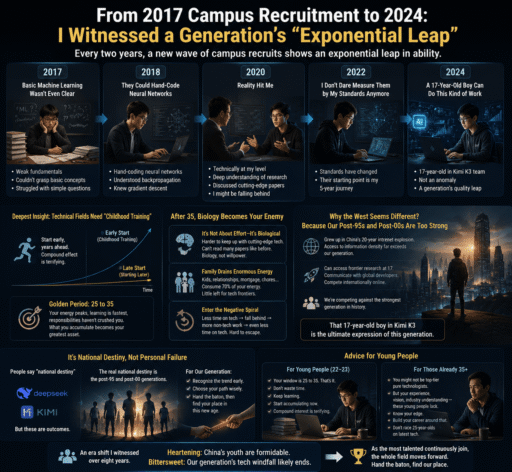
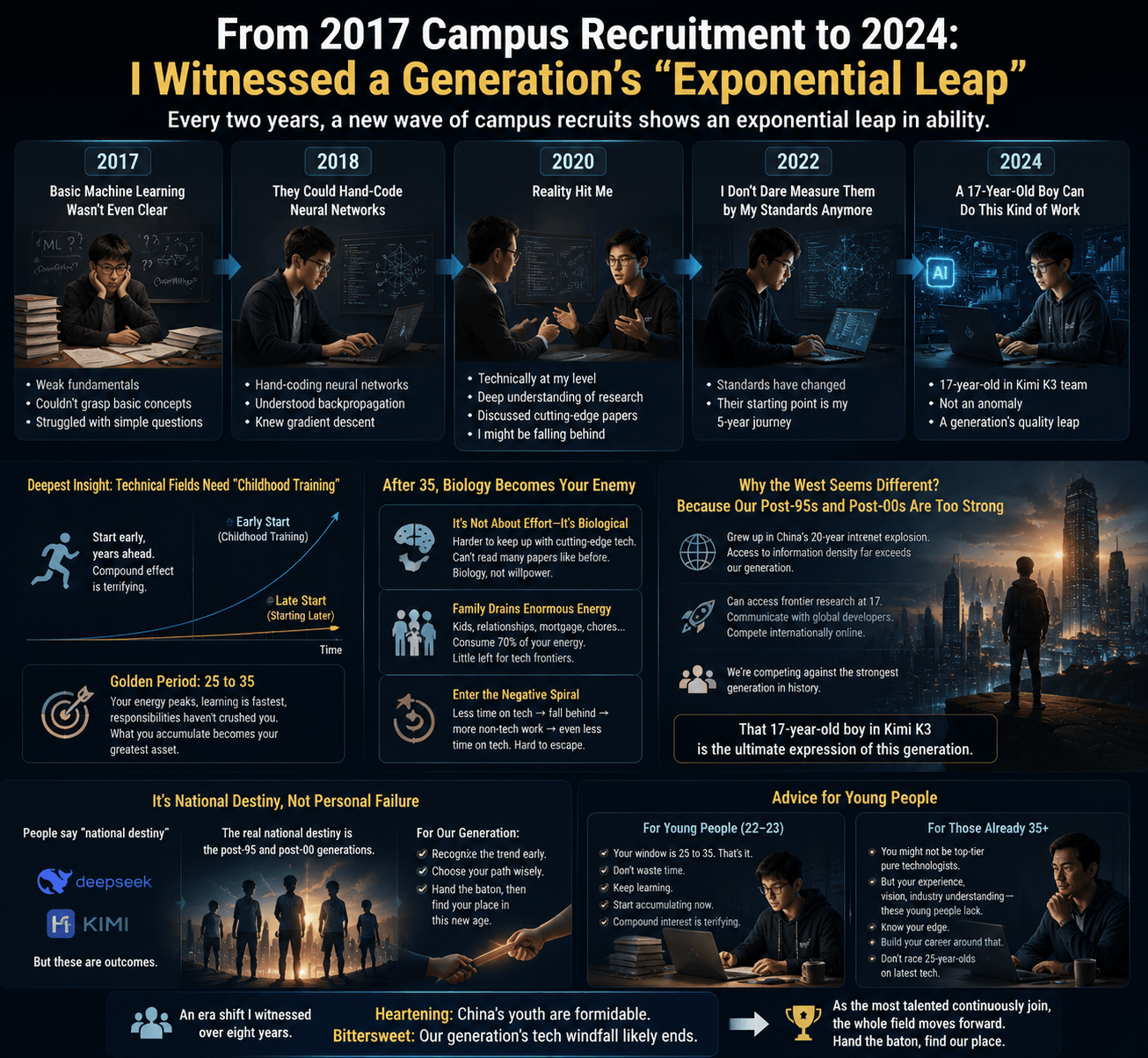
Every two years, a new wave of campus recruits shows an exponential leap in ability.
The Evolution I Witnessed Firsthand
2017: Basic Machine Learning Wasn’t Even Clear
Back then, campus recruits had weak fundamentals.
Many didn’t grasp basic ML concepts, let alone implement a complete neural network.
Interview questions that seemed simple would take them forever, or they couldn’t answer at all.
I thought, “Oh, this is what a fresh grad looks like. We’ll have to train them.”
2018: They Could Hand-Code Neural Networks
Just one year later, everything changed.
The new wave could hand-code neural networks. Not just calling libraries—they actually understood backpropagation, gradient descent.
I started thinking: curriculum updates? Better online education resources?
2020: Reality Hit Me
Around 2020, a critical turning point came.
The algorithm-track recruits I interviewed that year—technically, they were already at my level, despite my years of experience.
This isn’t false modesty. It’s honest.
They not only knew the basics. They deeply understood cutting-edge research. They cited recent papers, discussed latest model improvements.
And I realized: I might already be falling behind in some frontiers.
2022, 2024,2026: I Don’t Dare Measure Them by My Standards Anymore
By 2022 and 2026, honestly, I’ve stopped measuring them by the standards I had when I was young.
Because the standards themselves have changed.
Their starting point is where I took five years to reach.
This trend reached its extreme in Kimi K3’s team. A 17-year-old boy can do this kind of work.
This isn’t an anomaly. This is an entire generation’s quality leap.
Pure Technical Fields Require “Childhood Training”—My Deepest Insight From Eight Years
Why Some People Stay Ahead
I slowly realized one harsh truth:
Technical fields need childhood training. Start early, and you have years on everyone else. The compound effect of those years in tech is terrifying.
Run fast in the first five years, run even faster later. Others won’t even see your taillights.
That’s why some stay ahead of the curve while others gradually fall behind. Not because the latter are dumb—they just started too late.
The Golden Period: 25 to 35
If I had one piece of advice for technical professionals:
Your golden period is 25 to 35, like athletes.
In these ten years, your energy peaks, learning is fastest, family and social responsibilities haven’t yet crushed you.
What you accumulate in these ten years becomes your greatest asset in later career stages.
Conversely, waste these ten years, and no amount of later effort will catch you up.
After 35, Biology Becomes Your Enemy
It’s Not About Effort—It’s Biological
After 35, keeping up with cutting-edge tech genuinely gets hard.
It’s not an effort issue.
As Wang Xiaopo said, when young I too thought I was a beast who could forever keep pace with tech frontiers. But that’s an illusion.
At 25, I could really read many papers a day. Now I get drowsy just reading an abstract.
Thank God for AI reading it for me. Otherwise I’d be lost.
This is biology, not willpower.
Family Drains Enormous Energy
Family drains a lot of energy too. Young friends without families can’t imagine this.
You have kids to raise. A partner to maintain a relationship with. A mortgage to pay. Life’s countless small chores.
Together, these consume 70% of your energy.
The remaining 30% goes to work. What’s left for tech frontiers? Almost nothing.
Enter the Negative Spiral
Worse, when your tech skills start falling behind, non-technical work piles up.
Less time on tech → farther from the frontier → need more time on non-tech work to prove value.
A negative spiral: can’t keep up → invest less in tech → fall further behind.
Once you’re in this spiral, escape is hard.
Why the West Seems Different? Because Our Post-95s and Post-00s Are Too Strong
A Truth Rarely Stated
People ask why tech workers in the West don’t face such severe “35-crisis.”
This reason is rarely articulated. Today I’ll say it:
Because our post-95 and post-00 generations are too strong.
Silicon Valley has excellent young talent, sure. But the generational ability gap isn’t this extreme.
Why is our generational gap so large?
Because we’re in rapid growth. Not steady increase—exponential growth.
Post-95, Post-00: Possibly Strongest Generation Ever
I believe post-95 and post-00 might be the strongest generation since our nation’s founding vertically, and globally horizontally.
They grew up during China’s twenty-year internet explosion.
The elite among them access information density far exceeding our generation.
Our era: want cutting-edge knowledge? Read papers, English materials, attend lectures.
Theirs? Open your phone. Everything’s there.
They can access frontier research at 17. Communicate directly with global developers. Join international competitions online.
A completely different growth environment.
So This Is the Root of the 35-Crisis
When people discuss “35-crisis,” they often blame age discrimination or companies undervaluing senior staff.
But the real cause: we’re competing against the strongest generation in history.
You’re 35. Across from you stands a 25-year-old.
They’re smarter. Learn faster. Can work nights. Cost less. Know the latest tech better.
It’s not your problem. It’s not the company’s problem. It’s reality.
That 17-year-old boy in Kimi K3 is the ultimate expression of this generation.
This Is National Destiny, Not Personal Failure
Some Say “National Destiny”
People call DeepSeek “national destiny,” call Kimi “national destiny.”
I think those are just outcomes.
The real national destiny is the post-95 and post-00 generations.
Whether or not DeepSeek exists, whether or not Kimi exists, this generation’s quality already determines China’s technological ceiling.
What This Means for Our Generation
What does this mean for us?
Frankly, if you still want to compete in pure tech, starting now is already a bit late.
But this isn’t despair—it’s reality. Seeing clearly lets you choose smarter.
Some transition to management. Some to product. Some start their own ventures. All valid paths.
But you need to recognize this trend early, not at 38 when you realize you’re completely left behind.
Advice for Young People
Your Window Is This Short
If you’re 22, 23, just entering tech, I want to tell you:
Your window is 25 to 35. That’s it. No more.
Don’t waste time on work that looks busy but teaches nothing.
Don’t abandon learning new things because work is hard.
Don’t wait until 35 to discover you’re completely left behind.
Start accumulating now. Compound interest is terrifying.
For Those Already 35+
If you’re 35 or older, don’t despair.
You might not become a top-tier pure technologist. But that doesn’t mean you’re worthless.
Your experience, vision, industry understanding—these young people lack.
The key: know where your edge is, then build your career around that.
Don’t try outpacing 25-year-olds on latest tech. That’s a race you’ll never win.
Final Words
Over eight years, from an interviewer’s lens, I’ve watched an era shift.
This shift is both heartening—China’s youth are truly formidable—and bittersweet—our generation’s tech windfall likely ends.
But it’s not bad. It’s national progress.
As the most talented continuously join, the whole field moves forward.
Our generation’s job might be handing the baton to them, then finding our place in this new age.