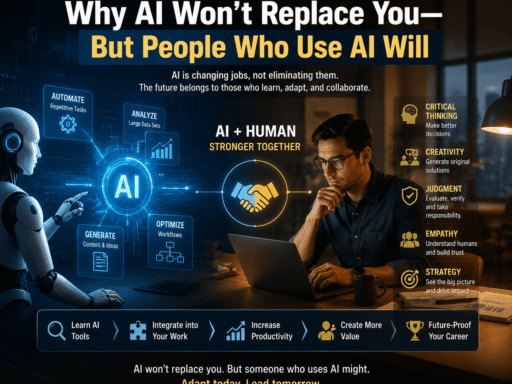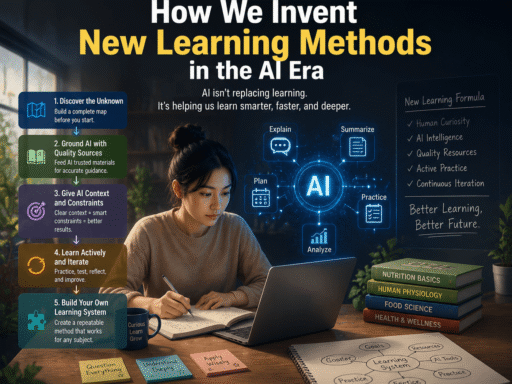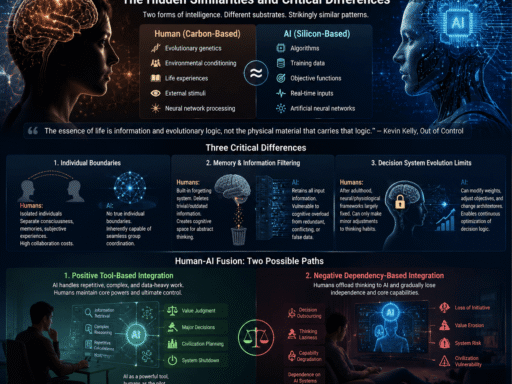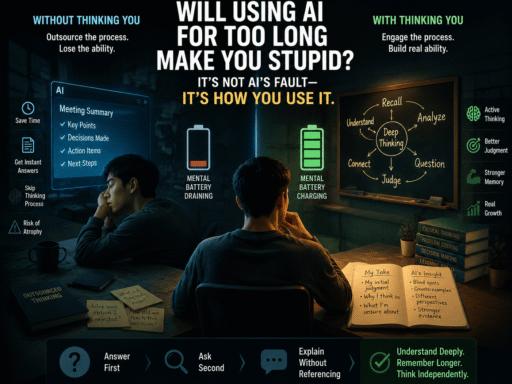

AI is changing almost every part of our lives.
At work, AI assistants are becoming normal tools.
People use AI to:
- Create presentations
- Generate images
- Write reports
- Analyze data
- Assist with programming
Developers use AI coding assistants like Copilot to speed up development.
Students are also experiencing a different kind of education. Many exams are moving away from pure memorization and focusing more on analysis, application, and solving complex problems.
Even during leisure time, AI is everywhere.
Recommendation algorithms decide what videos we watch, what articles we read, and what products we discover.
Customer service bots are available 24/7, providing instant answers.
AI has made information easier than ever to access.
But this creates a new question:
When machines become better at processing information, what should humans become better at?
The answer is not simply “learn more.”
In fact, the biggest advantage in the AI era may come from knowing:
What information matters, what information to ignore, and how to make better judgments.
I believe the future difference between people will come down to five thinking skills.
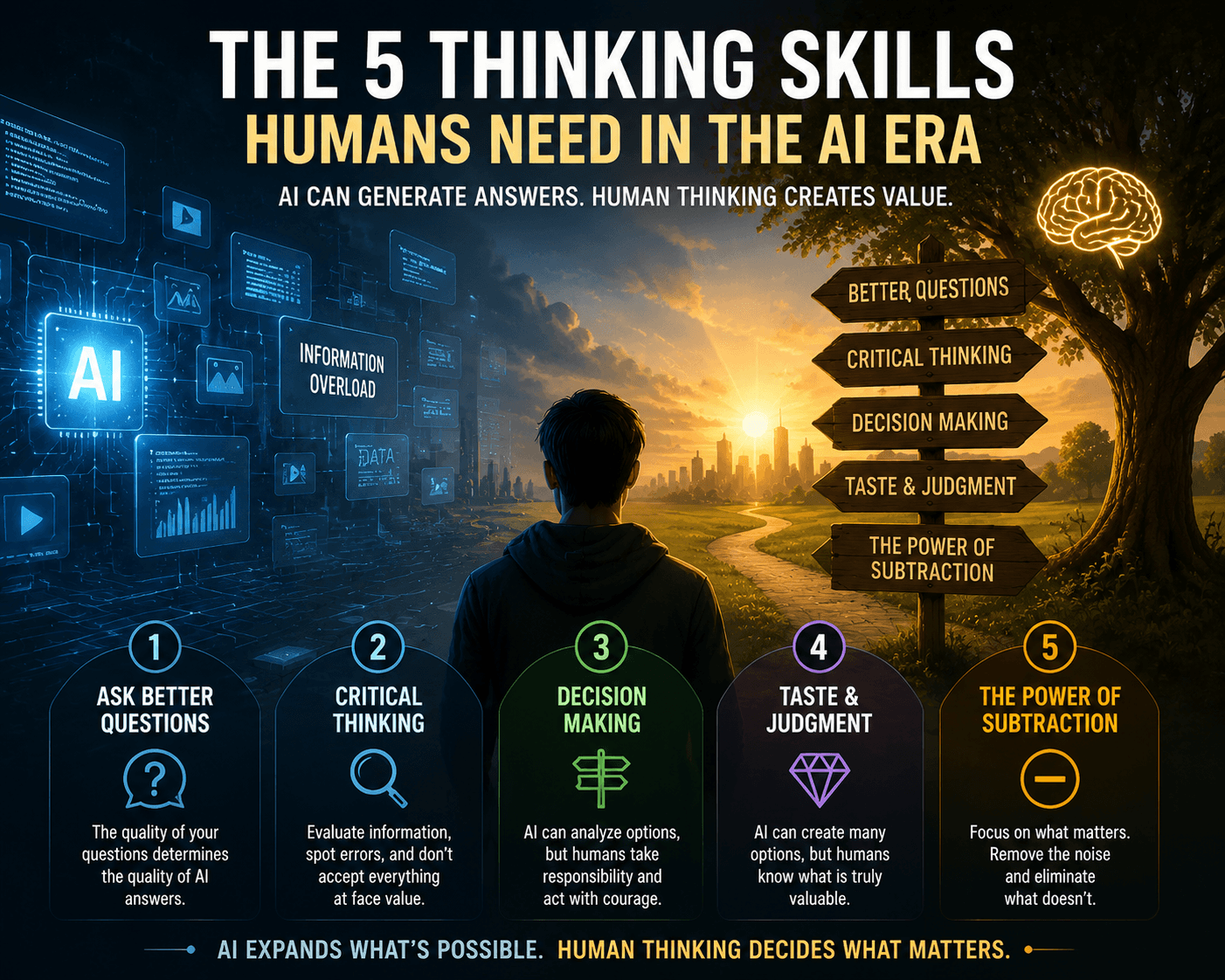
1. The Ability to Ask Better Questions
For decades, education focused heavily on finding correct answers.
Exams tested whether students could remember information.
Interviews tested whether candidates could provide solutions.
Presentations tested whether people could explain conclusions.
But AI changes the value of answers.
Today, almost anyone can ask AI a question and receive a detailed response within seconds.
The problem is:
A poor question still produces a poor answer.
AI is not a magic machine that automatically understands your real problem.
The quality of the output depends heavily on the quality of the input.
Compare these two questions:
“What skills should I learn in the AI era?”
This question is too broad.
The answer will probably become a generic list of popular skills.
Now compare it with:
“I am 26 years old, have three years of experience in operations, and currently work in e-commerce. Should I move into an AI SaaS product role or continue developing as an operations manager? Compare the five-year income potential, skill growth, and career risks.”
These are completely different questions.
The second question contains:
- Personal context
- Specific choices
- Clear evaluation criteria
The AI response will naturally become more useful.
The advantage in the AI era will not belong only to people who know how to use AI.
It will belong to people who understand their own problems clearly.
Because better questions create better decisions.
2. Critical Thinking: The Ability to Detect What Is Wrong
One of the biggest risks in the AI era is not refusing to use AI.
It is trusting AI too easily.
AI can produce answers that look extremely professional.
The structure is clear.
The language sounds confident.
The explanation appears logical.
But sometimes, important details are incorrect.
An expert may immediately notice:
- A false assumption
- A wrong data source
- A broken logical connection
A non-expert may simply think:
“This sounds very professional. It must be correct.”
This creates a new hierarchy of AI users.
The lowest level:
People who do not use AI and fall behind.
The middle level:
People who use AI but believe everything it says.
The highest level:
People who use AI as an assistant but constantly evaluate its output.
They ask:
“Where did this information come from?”
“Is this correlation or causation?”
“Is this example representative?”
“What assumptions are hidden here?”
AI can accelerate thinking.
But only humans can decide whether the thinking is reliable.
3. Decision-Making: The Ability to Take Responsibility
AI is becoming extremely good at analysis.
It can:
- Compare options
- Summarize advantages and disadvantages
- Predict possible outcomes
- Generate different strategies
But there is one thing AI cannot do:
Take responsibility for the result.
Imagine asking AI:
“Should I leave my current company and join a startup?”
AI can create a detailed SWOT analysis.
It can compare:
- Salary
- Growth opportunities
- Market trends
- Industry risks
But AI cannot truly understand what happens if:
- Your income suddenly decreases
- The startup fails after six months
- Your career path becomes uncertain
Why?
Because AI does not experience consequences.
It does not feel pressure.
It does not carry responsibility.
This is becoming one of the biggest differences between humans and AI.
In the past, having more information often meant making better decisions.
But in the AI era, information is becoming easier to obtain.
The difficult part is choosing.
When AI can provide ten possible paths, the challenge is no longer finding options.
The challenge is having the courage to choose one.
Great decision-makers are not people who wait until they have perfect information.
Perfect information rarely exists.
They make decisions with incomplete information, then adjust based on reality.
The ability to act, adapt, and accept responsibility will become more valuable.
4. Taste and Judgment: Knowing What Is Actually Good
Many people underestimate the importance of taste.
Taste is not only about fashion or design.
It is the ability to recognize quality.
AI can now generate:
- Hundreds of logo concepts
- Dozens of article ideas
- Multiple business strategies
- Different design solutions
The problem is no longer:
“Can we create something?”
The problem is:
“Which one is actually worth choosing?”
This requires judgment.
A person with strong taste can quickly recognize:
“This is acceptable.”
“This is interesting.”
“This is good, but not great.”
“This should never be published.”
That ability usually comes from years of experience.
A designer creates hundreds of drafts.
A writer studies thousands of sentences.
A businessperson makes countless decisions.
Through repeated experience, people develop an internal standard.
AI can reduce the cost of creation.
But it increases the value of judgment.
When everyone can create something decent with AI, the ability to recognize excellence becomes the real advantage.
5. The Power of Subtraction: Knowing What to Ignore
This may be the most underestimated skill in the AI era.
AI naturally creates more.
More information.
More ideas.
More possibilities.
More tools.
More options.
But human attention is limited.
Your brain does not have unlimited processing power.
The biggest problem today is no longer:
“How do I get more information?”
It is:
“How do I avoid drowning in information?”
In the past, information was scarce.
People needed to collect more.
Today, information is everywhere.
The new challenge is filtering.
Successful people are not necessarily those who consume the most information.
They are often the people who know what to ignore.
They know:
- Which news does not matter
- Which tools are unnecessary
- Which opinions are distractions
- Which tasks should be removed
Adding more is easy.
Removing the unnecessary is difficult.
But this ability creates focus.
And focus creates long-term advantage.