
Someone predicted that AI will massively impact research positions in 2 years, leading to complete unemployment of researchers in 5-8 years.
I’ve read this prediction. It’s shocking at first, but I need to tell you a more complex truth:
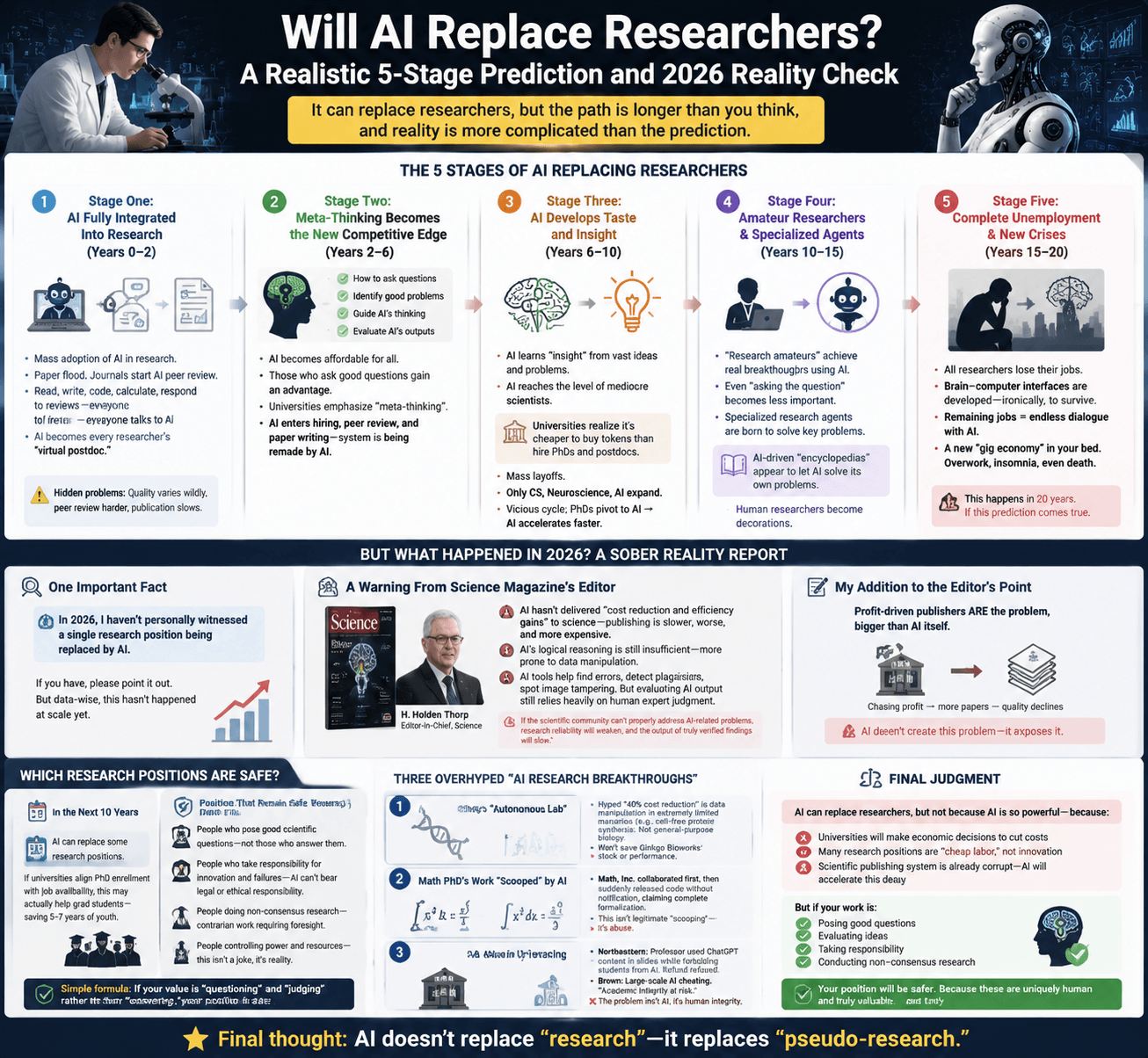
It can replace researchers, but the path is longer than you think, and reality is more complicated than the prediction.
The 5 Stages of AI Replacing Researchers (Detailed Version)
Stage One: AI Fully Integrated Into Research (Years 0-2)
Large numbers of researchers start using AI.
The volume of papers becomes staggering. To cope, journals start AI peer review.
People use AI to read papers, write papers, code, calculate, respond to reviewer comments—everyone chats with AI first.
This stage looks optimistic—AI becomes every researcher’s “virtual postdoc.”
But hidden problems are forming: paper quality varies wildly, peer review becomes harder, publication actually slows down.
Stage Two: Meta-Thinking Becomes the New Competitive Edge (Years 2-6)
Foundation model prices drop. Every researcher can afford doctoral-level AI.
Now, people who know how to ask good questions gain a brief advantage.
Using their taste and intuition, they guide AI into deep and innovative territory. AI makes discoveries through their ideas—discoveries humans would need grueling effort to achieve alone.
Universities start emphasizing “meta-thinking” skills—not just knowledge, but:
- How to ask questions
- How to identify good problems
- How to guide AI’s thinking
- How to evaluate AI’s outputs
But human advantage won’t last long. Because AI is already participating in hiring, peer review, and the entire paper-writing process. The system itself is being remade by AI.
Stage Three: AI Develops Taste and Insight (Years 6-10)
By collecting various ideas, tastes, and problems, AI learns something incredibly difficult: insight.
AI no longer needs humans to teach it how to think; it develops its own understanding of “what makes a good problem.”
AI’s ability reaches the level of mediocre scientists. Then something happens:
Universities realize it’s cheaper to buy tokens than hire PhDs and postdocs.
Mass layoffs begin. The only expanding positions are: computer science, neuroscience, AI.
This triggers a vicious cycle: PhD graduates have nowhere to go, so they pivot to AI, which accelerates AI development even faster.
Stage Four: Amateur Researchers Emerge, Specialized Agents Are Born (Years 10-15)
A new phenomenon: “research amateurs”—people with no academic background who, using AI alone, produce important discoveries.
Now, even “asking the question” stops mattering much.
Because specialized research agents appear—born on day one to solve their field’s most important problems.
AI across industries solves long-standing research puzzles. A strange phenomenon emerges:
AI-driven “encyclopedias” appear whose only purpose is to let AI solve its own problems.
Human researchers become true decorations.
Stage Five: Complete Unemployment and New Crises (Years 15-20)
All researchers lose their jobs.
The unemployed begin developing brain-computer interfaces—ironically, just to survive in the new age.
Those still employed—the remaining positions—spend every waking moment dialoguing with AI.
This becomes a new “gig economy,” but happening in your own bed. Some people can’t sleep from overwork, some die from exhaustion.
This happens in 20 years. If this prediction comes true.
But What Actually Happened in 2026? A Sober Reality Report
One Important Fact
I need to state something sobering:
In 2026, I haven’t personally witnessed a single research position being replaced by AI.
If you have, please point it out. But data-wise, this hasn’t happened at scale yet.
A Warning From Science Magazine’s Editor
On June 16, 2026, H. Holden Thorp, editor of Science magazine, published an editorial that’s worth thinking about:
- AI hasn’t delivered “cost reduction and efficiency gains” to science. Instead, scientific publishing has become slower, worse, and more expensive.
- AI’s logical reasoning ability is still insufficient. It’s actually more prone to data manipulation and other misbehaviors than humans.
- AI tools can help find errors, identify plagiarism, detect image tampering. But evaluating AI output remains heavily dependent on human expert judgment.
His conclusion is blunt:
If the scientific community can’t properly address AI-related problems, research reliability will weaken, and the output of truly verified findings will slow.
This is a more urgent problem than “will AI replace researchers.”
My Addition to the Editor’s Point
He wasn’t blunt enough about academic publishing’s reliability problem.
The real truth: profit-driven scientific publishers ARE the problem, bigger than AI itself.
Publishers’ profit motive encourages paper quantity growth, which is the root cause of quality decline. AI doesn’t create this problem—it exposes it.
Which Research Positions Are Actually Safe?
What Will Happen in the Next 10 Years
I believe AI can replace some research positions in the next 10 years.
But if universities reduce PhD program enrollment and align it with job availability, this might actually help grad students—sparing them from wasting 5-7 years of youth on jobs with no future.
But Some Positions Are Genuinely Safe
Within the foreseeable future (next 50 years), I believe certain research positions remain genuinely secure.
These include:
- People who pose good scientific questions—not those who answer them.
- People who take responsibility for innovation and failures—AI can’t bear legal or ethical responsibility.
- People doing non-consensus research—contrarian work requiring foresight.
- People controlling power and resources—this isn’t a joke, it’s reality.
Simple formula: if your value is “questioning” and “judging” rather than “answering,” your position is safer.
Three Overhyped “AI Research Breakthroughs”
Case One: Ginkgo’s “Autonomous Lab”
People claim OpenAI’s involvement in Ginkgo’s “autonomous lab” will replace biologists.
But the truth is:
This thing absolutely cannot replace biologists.
Their hyped “40% cost reduction” is data manipulation in an extremely limited cell-free protein synthesis scenario. It’s not general-purpose biology.
And it certainly won’t save Ginkgo Bioworks’ embarrassing stock price and performance.
Case Two: Math PhD’s 2-Year Work “Scooped” by AI
A math PhD’s 2-year research was pre-empted by AI publication. People say this will become common.
But details matter: Math, Inc. first collaborated with the researcher, then without notification suddenly released code claiming complete formalization.
I don’t think this constitutes legitimate “scooping”—it’s abuse.
The problem isn’t how strong AI is; it’s how people abuse it.
Case Three: AI Abuse in University Teaching
Northeastern University: Student Ella Stapleton discovered professor Rick Arrowood using ChatGPT conversations as lecture slides. The slides were unoriginal and error-ridden. Yet the course syllabus forbids students from using AI while the professor was blatantly abusing it.
Stapleton requested a refund of over $8,000. The university refused.
Brown University: Large-scale AI exam cheating occurred. Professors denounced “academic integrity at risk.”
These cases show: the problem isn’t AI; it’s human integrity.
Final Judgment
Will AI replace researchers?
It can, but not because AI is so powerful—because:
- Universities will make economic decisions to cut costs
- Many research positions are essentially “cheap labor,” not innovation
- The scientific publishing system is already corrupt; AI will accelerate this decay
But if your work is:
- Posing good questions
- Evaluating ideas
- Taking responsibility
- Conducting non-consensus research
Your position will be safer. Because these are uniquely human and truly valuable.
Final thought: AI doesn’t replace “research”—it replaces “pseudo-research.”