
It can. But it depends on how you use it.
To be precise, AI won’t work like a virus that suddenly tanks your IQ. The more realistic risk is this: when you outsource the thinking process that you used to do yourself to AI, certain abilities atrophy from disuse.
Let’s Start With a One-Hour Meeting
Imagine a one-hour meeting.
Before, you had to write the meeting notes yourself.
This meant you had to recall: Who said what? Where did the disagreement happen? Why did we choose A instead of B in the end? Which comments were just polite talk, and which ones meant a task actually landed on your shoulders?
This process itself is a deep cognitive exercise. You’re recalling, judging, filtering, and reorganizing information in your own language. The notes that resulted were just the final document—what actually helped you understand the meeting was the entire process of creating those notes.
Now, you hand the recording to AI.
In seconds, you get a well-structured, clearly highlighted summary. You read through it once and feel like you’ve grasped everything.
But two days later, a colleague asks: “Why was the second option rejected back then?”
You might only remember the few sentences from the AI summary, but you can’t clearly explain how the discussion got to that conclusion step by step.
This isn’t AI “deleting” your memory. What’s more likely is that you never actively processed that information in the first place.
What Gets Cut Isn’t Just Time
When you outsource the entire process to AI, you’re not just saving yourself the organizational work—you’re also losing the cognitive processing that would have happened.
And cognitive processing is where real learning and ability retention come from.
A Serious Study Backs This Up
A CEPR discussion paper released in 2026 studied 26,811 Chinese students in grades 7-12 over 30 months.
Rather than simply comparing “students who use AI” vs. “students who don’t,” the researchers used the staggered adoption of generative AI as a natural experiment—making their findings more credible.
Here’s what they found:
- After adopting generative AI, students’ homework scores increased by 18%
- Homework completion time decreased by 30%
- But their closed-book monthly exam scores dropped by 20% within six months
- Two types of standardized test scores declined by 18% and 24% respectively
- The complete impact took about two years to fully emerge
Sounds contradictory, right? Homework scores up, test scores down.
But here’s what’s really important: this decline wasn’t evenly distributed.
The grade decline was concentrated among roughly 80% of AI users who showed signs of “homework outsourcing”—completing assignments in unusually short times with high scores.
In contrast, students who used AI but still spent about as much time on homework as non-AI users suffered minimal learning loss.
Original paper: CEPR “The Generative AI Learning Penalty”
This is a discussion paper studying middle school students, so we can’t directly claim it proves all adults who use AI will get dumber.
But it does strongly support a crucial insight:
The issue isn’t whether you use AI—it’s whether you outsource the entire learning process along with it.
The Real Risk: “Process Outsourcing”
I prefer to call this risk “process outsourcing.”
A report’s output is thousands of words, but its generation process includes:
- Defining the problem
- Finding evidence
- Handling contradictions
- Forming conclusions
Code’s output is a working program, but its generation process includes:
- Understanding requirements
- Breaking down the problem
- Judging exceptions
- Debugging errors
Meeting notes’ output is a few pages of documentation, but its generation process includes:
- Recalling
- Filtering
- Understanding each party’s true intent
AI can hand you the result directly. But if the result appears while the process never happens inside your mind, the tool’s capability easily gets mistaken for your own.
In the past, the direct consequence of not thinking was producing no answer. Now, even without serious thinking, you can still produce a beautifully polished result.
This is what AI’s real weakness is often overlooked: it doesn’t necessarily make you stupid immediately, but it makes “not thinking” temporarily cost-free.
Whether you’ve actually retained the ability is only revealed when AI isn’t available, when answers are wrong, or when reality demands independent judgment.
When to Cut Corners, When Not To
Of course, this doesn’t mean everything should be done manually.
Let AI transcribe recordings instead of listening word-by-word yourself;
Let AI format documents instead of manually laying everything out first;
Resource searches, candidate information organization, repetitive work—all fair game for AI to handle first.
What truly needs to be preserved are those steps that determine whether a result is reliable:
- What is the problem exactly?
- Which evidence is actually trustworthy?
- Why do different pieces of information conflict?
- What conclusion should I actually reach?
- Why am I willing to take responsibility for this conclusion?
If you outsource all of these, you hit a serious problem:
Judging whether an AI’s answer is reliable requires judgment ability itself. If AI does all the reasoning for years, what will you use to check its reasoning with?
A Simple But Effective Use Pattern
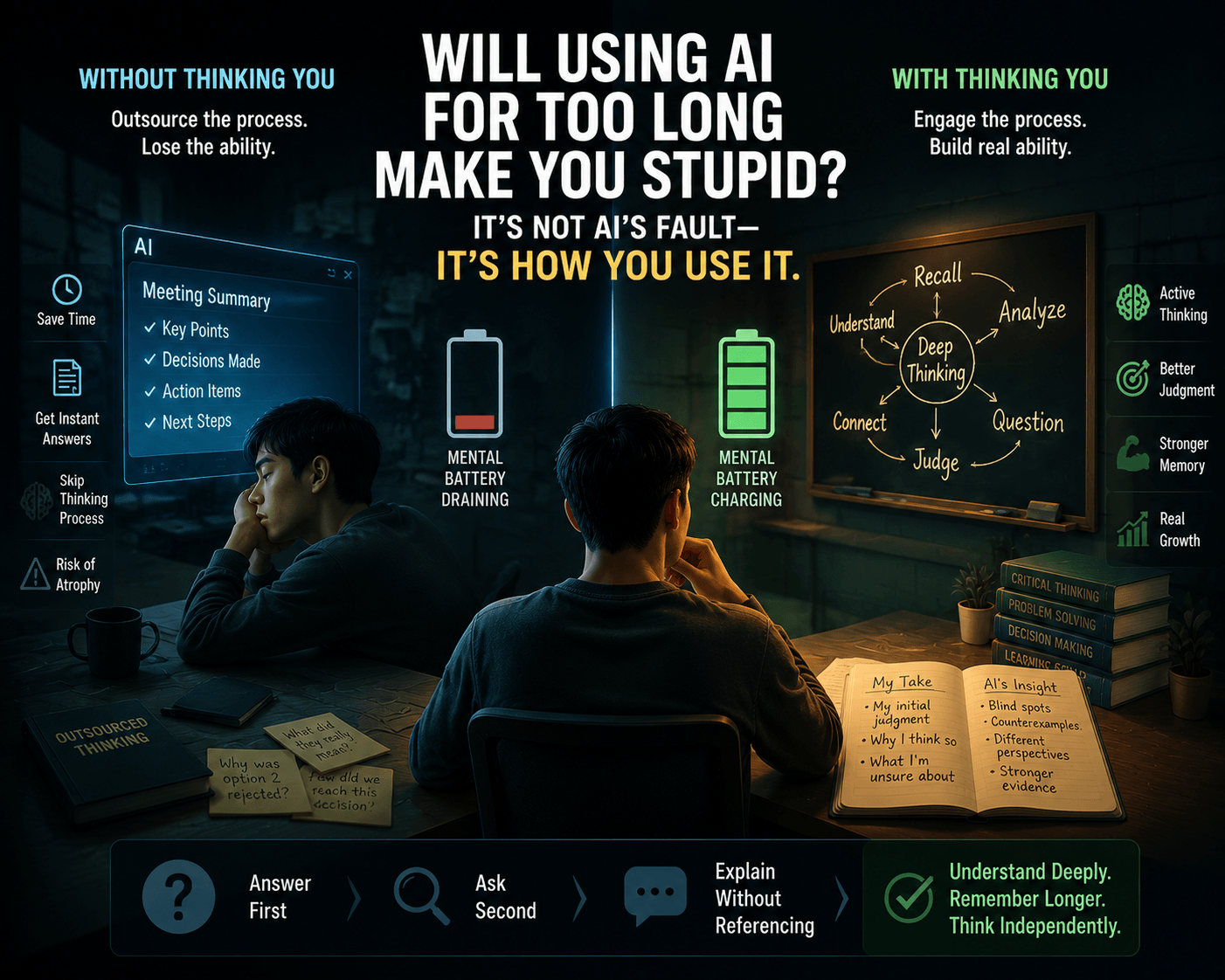
I now recommend a straightforward approach: Answer first, ask second, explain without referencing.
Step One: Answer First
Before opening AI, write three sentences:
- What’s my initial judgment?
- Why do I think that?
- What am I most uncertain about?
It doesn’t need to be perfect; even if you’re wrong, that’s fine. Its only purpose is to ensure the problem gets processed in your brain first.
Step Two: Ask Second
Then ask AI. Instead of having it generate from scratch, let it:
- Disagree with you
- Find your blind spots
- Supply counterexamples you missed
- Point out what you overlooked
Step Three: Explain Without Referencing
Finally, close the page and explain it in your own words.
If you can’t articulate it without the AI text, can’t explain “why,” or can’t judge which parts might be wrong, then this answer doesn’t actually belong to you yet.
Not every small task deserves this full process. But for any result that affects your important decisions, external commitments, or abilities you want to retain long-term, leave yourself one “AI-free round.”
The Final Question
So, will using AI for too long make you stupid?
AI itself won’t automatically make you dumb. But if you use it every time to skip thinking, what gets weakened isn’t vague “intelligence”—it’s very specific abilities:
- Recall
- Expression
- Reasoning
- Judgment
- The ability to independently start with a blank page
Worse, this atrophy gets hidden behind increasingly polished outputs.
Next time you’re about to hand a task to AI, ask yourself:
Am I cutting out repetitive work, or am I skipping a practice session I should be doing?
The former definitely should be cut. Cut the latter too much, and what you lose might be more than just time.
If you can close AI and still explain, question, and use its answers in your own words, then AI truly made you stronger.
If closing it leaves you with only beautiful words you can’t articulate, then what got outsourced wasn’t just labor.