
A real-world case study: How I went from zero background to earning a UK Level 2 Nutrition Certificate—and built a replicable learning system using AI.
Updated: July 2026 · Read time: ~14 min
Recently, I completed a small but transformative experiment: using AI to rapidly enter a completely unfamiliar domain and discovering that knowledge doesn’t have to be a barrier anymore.
The goal was concrete: from zero background, systematically study nutrition and earn the UK Level 2 Nutrition Certificate.
Sounds like another “AI is all-powerful” story? In reality, it’s far more nuanced—and far more revealing about how learning actually works.
I had no medical, biology, or STEM background. My existing nutrition knowledge came entirely from casual conversations and social media. If this learning journey was like entering an unfamiliar forest, AI could give me an axe—but it couldn’t tell me what trees were actually in there, which paths led nowhere, or what lakes existed that I didn’t even know about.
This isn’t a story about “using AI to cheat assignments.” It’s a record of how one ordinary person, in the AI era, reinvented a learning system that could work for any new domain.
Step 1: I Don’t Know What I Don’t Know
It appears that AI can answer anything. But for someone truly new to a field, the greatest difficulty is often not finding answers—it’s not knowing what questions to ask.
This sounds like a trivial distinction, but it determines the entire efficiency of your learning journey.
Questions don’t emerge from nowhere. They build on existing knowledge networks. When a field is completely foreign to you, your brain lacks enough concepts, categories, and logical relationships. Naturally, you don’t know which questions matter, which are just minor details, and especially—which knowledge exists that you’re completely unaware of.
So where do I start? I asked AI to generate a framework for nutrition. It did. But I had no confidence in it. Was it right? Was it complete? I was like someone fumbling in a dark room with a map I couldn’t read.
So I did something practical: I enrolled in an actual Level 2 Nutrition course.
Then I did something crucial: I laid my AI-generated framework side-by-side with the official course syllabus and compared them.
In my mind, nutrition was mainly about nutrients, food composition, and healthy eating principles. Simple, right?
When I saw the full syllabus, I realized it was vastly more comprehensive:
- Dietary requirements for different age groups
- Weight management and energy balance
- Eating behavior and psychological factors
- Reading and interpreting food labels
- Food additives and safety standards
- Home food safety and food storage
- How different cooking methods affect nutrient content
- Dozens more topics I never knew existed
This was the moment I truly understood: The greatest value of systematic learning isn’t the answers it provides—it’s showing you what an entire domain actually looks like.
Once I had that complete framework in my head, every new fact had a place to belong. Learning suddenly became far more efficient. AI wasn’t just a search engine anymore—it became a guide with actual coordinates.
Step 2: AI as a Personal Tutor Needs Grounding
Here’s where things get really interesting.
I took all the course materials, lecture slides, and study resources the teacher provided—everything—and uploaded them into my personal LLM Notebook. Now, instead of AI searching the entire internet for answers, it answers based only on the materials I’ve specified.
This is what’s called “grounding.” And it’s a game-changer.
Without grounding, AI searches the whole internet for answers, many of which are outdated or just plain wrong. In nutrition especially, social media is flooded with debunked low-fat myths, superfood hype, and unproven “detox” theories.
Now, AI became something else entirely: a personal tutor familiar with this exact curriculum. It could quickly explain concepts, organize key points, help me review, and shield me from the noise of unverified internet content.
Key insight: Often, what determines the quality of AI output isn’t just the model itself. It’s the knowledge environment you’ve built around it.
In the AI era, information reliability doesn’t depend on how fast you search. It depends on what boundaries you set for the AI.
Step 3: AI Needs Smart Constraints (Context & Restraint)
Now, AI starts delivering real value.
One assignment: Design a day’s meal plan for a client with specific age, health status, activity level, and weight loss goal. Calculate the calories and nutrient ratios. If I did this entirely by hand, it would take forever.
So I redesigned how I asked AI for help. I gave it complete context before asking:
Context I provided:
“This is a day’s meal plan for home cooking, using common supermarket ingredients and basic cooking methods. It must meet the course’s required energy and nutrient ratios, adjusted for this person’s age, activity level, and weight loss goal.”
Then I added my own constraints (Restraint):
Constraints I set:
“Avoid these foods (due to allergies or preferences). Total cooking time shouldn’t exceed 30 minutes. Stay within a £X budget per day.”
The more complete your context, the clearer your constraints, the higher the quality of AI’s output.
It no longer gave me an “ideal but impossible to cook” menu. Instead, I got something my mom could actually prepare in her kitchen. Constraints transform AI from a general knowledge bank into a specific problem-solver.
Step 4: Use AI to Break Beyond Boundaries (Critical Thinking)
At a certain point, I realized the textbook itself has limits.
Nutrition is an evolving field. Today’s mainstream views rest on current research evidence, but that doesn’t mean tomorrow won’t bring changes. If AI only ever answers what’s in the textbook, it’s reliable but also risky—it could lock me into thinking the textbook is the complete truth.
So I shifted how I used AI. Instead of just asking “what does the textbook say,” I started asking:
- What controversies exist in this topic?
- Which new studies challenge traditional views?
- Why do different countries’ nutrition guidelines differ?
- What evidence supports each viewpoint?
- Which populations are these recommendations for?
- What questions still remain unanswered?
Take the question of fat intake. Different countries’ guidelines, different research directions, and recent evidence all show interesting differences worth examining.
Rather than getting one “correct answer,” I wanted to understand: Why do these viewpoints differ? What’s different about their research designs? Who are these recommendations for? What problems haven’t been solved yet?
I discovered that AI’s real power, at this stage, isn’t replacing your thinking. It’s helping you see more angles worth thinking about.
AI can rapidly collect different perspectives. It can help organize evidence. It can compare logic. But it can’t replace your final judgment. This is when I truly understood:
AI’s job is to expand what you see. Your job is to decide what it means.
Step 5: A Bittersweet Lesson—Using AI to Defeat AI
The course uses AI content detection systems to check assignments, ensuring students actually learned rather than just copying AI outputs.
My typical process: First, I’d form my own thinking based on course content. Then use AI to organize structure, refine wording, check logic. Finally, output the final version.
As a non-native English speaker, AI helped me generate fluent English quickly. But there was a problem: the English was too perfect—so perfect that the detection system would flag it as AI-generated.
Frustrated, I started manually rewriting it into awkward “Chinglish.” But that took forever. So I did something clever (maybe too clever): I used Claude Code to redesign my prompt, creating a second AI that rewrote the first AI’s answer, then checked it against the detection system.
My first AI’s English was revised by a second AI—and it passed the detector. I was literally using AI to defeat AI.
Was this ethical? Was I just cheating in a more sophisticated way? Probably somewhere in the gray zone. But here’s what I genuinely believe: Throughout this entire process, AI participated in the writing, but it never replaced my thinking.
This episode actually reveals something deeper about the AI era: The real challenge isn’t managing AI. It’s managing the relationship between you and AI.
I’m increasingly convinced that future competitive advantage won’t go to people who never use AI, nor to those who outsource everything to AI. It will go to people who know which tasks to give to AI and which judgments must remain human.
The Real Learning: Design Your Own Learning System
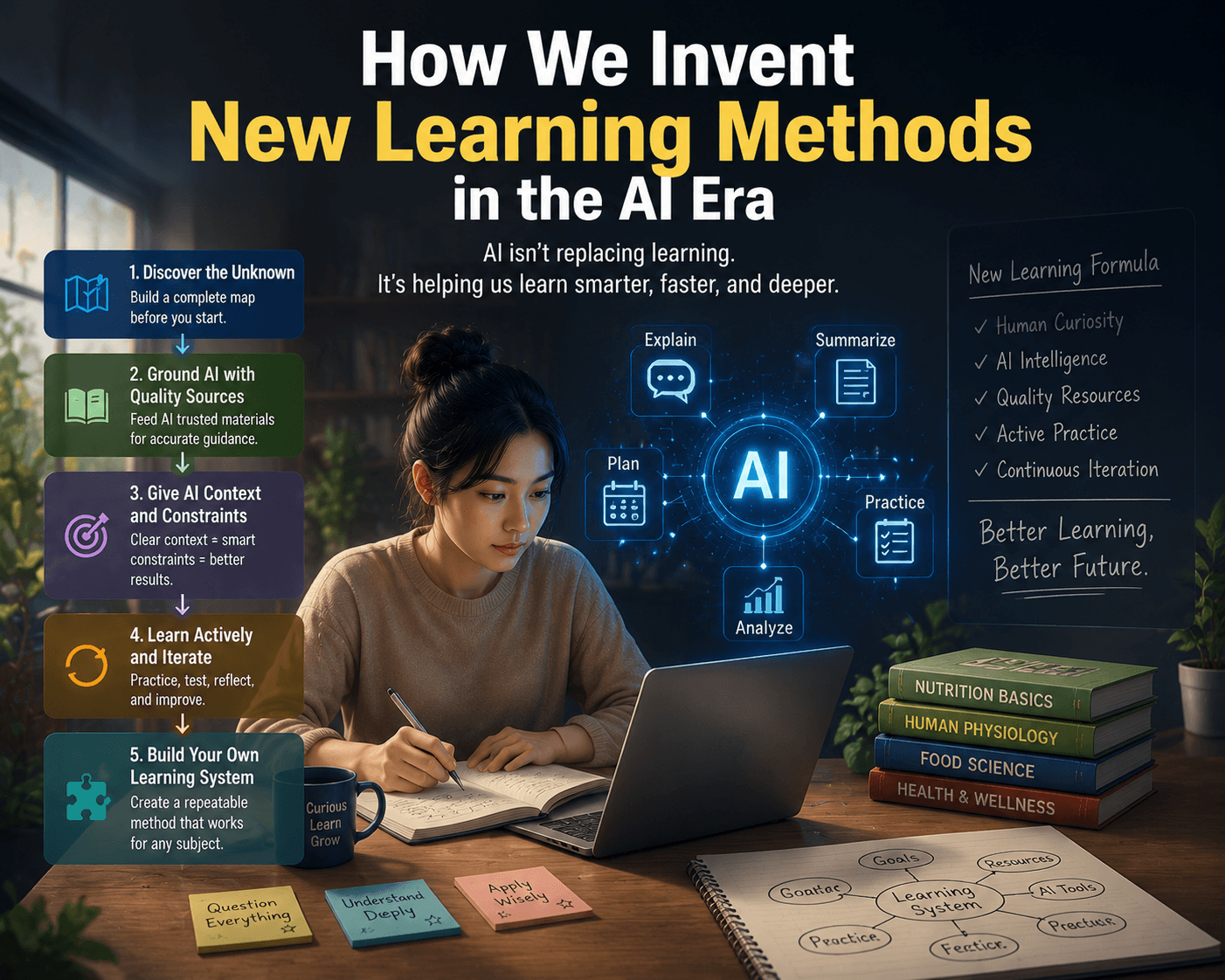
Looking back, the biggest takeaway from learning nutrition wasn’t mastering nutrition knowledge. It was building a replicable system for learning any unfamiliar domain.
When I tackle any new field in the future, I won’t start by searching. I’ll follow this system:
① Find Authoritative Curriculum
Find an official course or textbook. Build a complete knowledge framework (solving the “I don’t know I don’t know” blindspot).
② Deepen With AI Assistance
Use AI to deeply understand knowledge, support practice, and help review and reflect.
③ Build a Grounded Knowledge Base
Create your own knowledge repository (LLM Notebook / grounding documents), letting AI pull from trustworthy sources, not random internet searches.
④ Actively Engage With Frontiers
Use AI to explore new research, different perspectives, and academic debates. Continuously update your understanding rather than settling for textbook conclusions.
Throughout this system, AI remains just a tool. The learner is the system’s architect.
Maybe this is the skill worth cultivating in the AI era: Not whether you use AI, but how you design a learning system where AI serves your thinking rather than replacing it.
Information Depreciated, Systems Appreciated
AI has lowered the threshold for accessing knowledge. But it has raised the bar for wielding knowledge.
Future learning efficiency won’t be determined by diligence or memory alone. It will depend on whether you can design your own learning system—knowing when to rely on AI, when to verify it, when to challenge it, and when to return to the most fundamental, most reliable frameworks.
I’m increasingly convinced: The real gap between people in the future won’t be who owns AI. It will be who better understands how to learn alongside AI.
What’s truly scarce:
- Not information — but systems
- Not answers — but judgment
- Not tools — but the ability to continuously learn and update your own understanding
If you’re standing at the entrance to some unfamiliar domain, feeling lost—don’t rush to ask AI “what’s the answer?”
Instead, ask yourself: How do I design a system that helps AI show me the full landscape of this forest?
That’s the new learning method worth inventing in the AI era.