
Career & Technology
A practical, data-grounded guide for ordinary workers navigating the AI restructuring of skills—not jobs.
Lately, everyone is asking the same anxious question:
“Will AI take my job?”
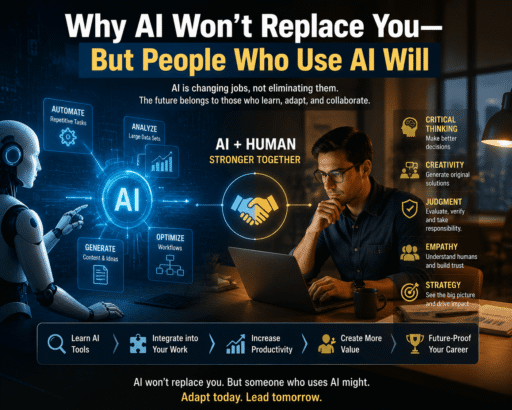
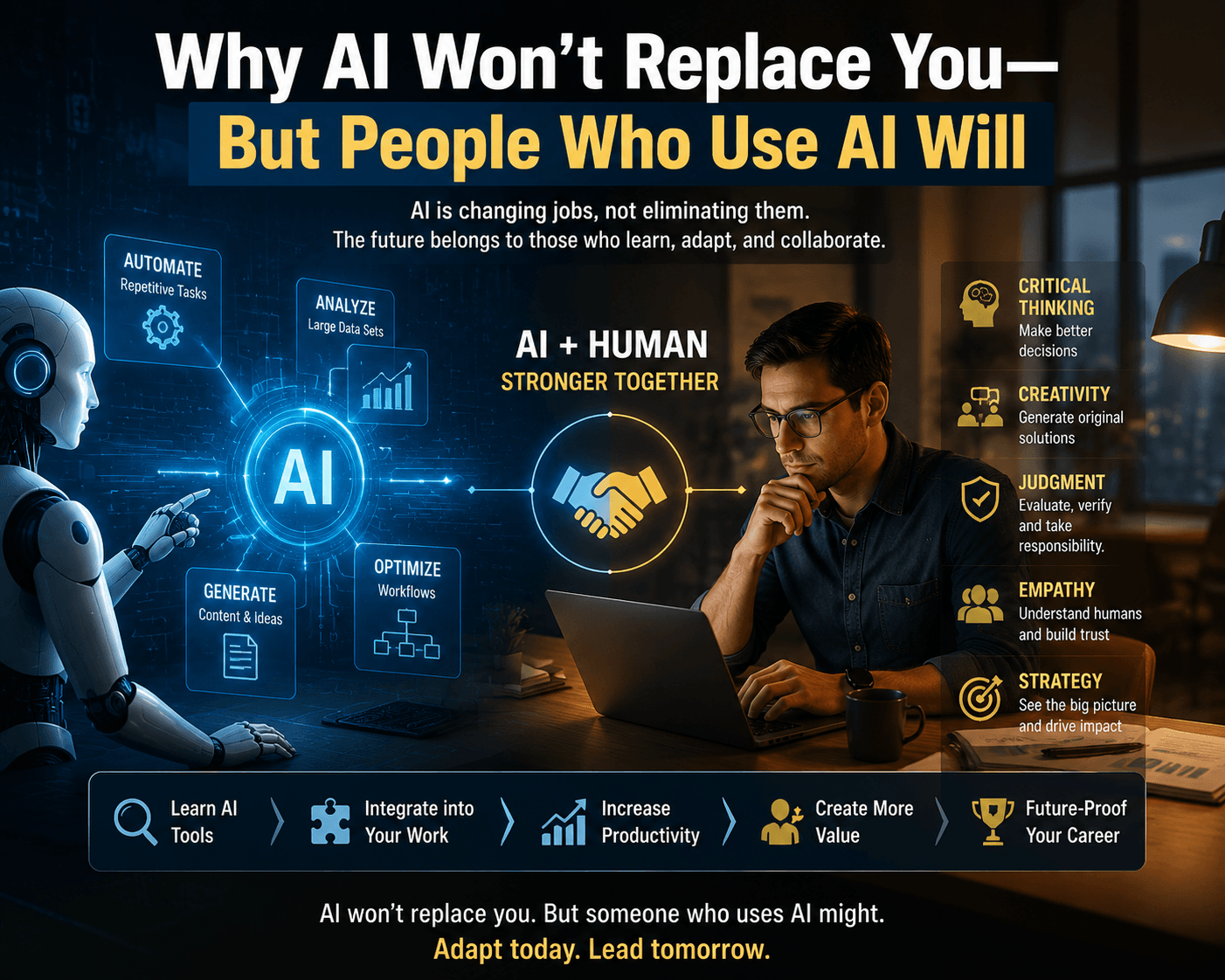
When AI can write copy, build spreadsheets, organize data, generate code, and assist with analysis, anxiety is only natural. But this phrase—“AI won’t replace you, but people who use AI will”—is not saying that anyone who fails to learn AI will be fired tomorrow, nor is it claiming AI will replace every human.
What it really warns us is far more concrete: AI rarely eliminates an entire profession in one sweep. Instead, it replaces specific tasks within that profession. Meanwhile, people who can leverage AI may complete more value in the same amount of time.
1. See the Data Clearly: AI Automates Tasks, Not Always Entire Jobs
One of the most common misreadings of AI employment research is confusing “the share of working hours that could be automated” with “the share of jobs that will disappear.” These are not the same thing.
According to research by McKinsey Global Institute (referencing studies on European employment impact), a significant portion of current working hours could theoretically be automated by 2030—part by AI agents, part by robotics. However, the report specifically clarifies:
Roughly 58% of working time having automation potential does not mean 58% of jobs will vanish.
Most jobs are made up of many different tasks. Take an operations manager, for example. Their work includes organizing data, writing event copy, analyzing feedback, designing strategy, and communicating with teams. AI may rapidly complete the first few tasks, but it is unlikely to independently carry out the full operational responsibility—or take final accountability.
How to think about your own job
| Job Characteristic | Typical Tasks | Likely AI Impact |
|---|---|---|
| Highly structured / routine | Data entry, invoices, basic reports, formatting | Higher automation exposure |
| Mixed / collaborative | Sales support, customer service, healthcare assistance, analysis | Workflow reshaped; human remains core |
| Human-centered / non-routine | Complex decisions, management, negotiation, emotional communication | Depends heavily on judgment & responsibility |
McKinsey-related research also notes that about three-quarters of employer-demanded skills are used for both automatable and non-automatable activities. Most skills will not vanish; they will be redeployed into new human-machine collaboration scenarios.
2. Who Is Most at Risk?
AI does not choose victims by “education level” or “professional prestige.” It enters work with these features first:
- Highly standardized processes
- Outcomes that can be digitized and measured
- High repetition; mainly text, table, and information processing
- Limited need for complex interpersonal negotiation
That is why some mid-skill, repetitive information-processing roles may feel pressure earlier than traditional manual jobs—such as routine data entry, basic financial processing, simple document organization, standardized customer replies, and repetitive entry-level analysis.
The hidden danger for young professionals
Previously, these tasks served as the “training ground” for newcomers. But now, AI completes part of that work instantly. If entry-level practice tasks disappear, the next generation must demonstrate earlier that they can define real problems, design solutions, verify AI outputs, and take responsibility for results.
3. Where Are the Opportunities?
Looking at recruitment trends, AI industry hiring is shifting from “pure algorithm competition” to industrial implementation and compound capabilities. Data cited in original reports suggests growth in roles combining hardware, architecture, embedded development, and domain expertise—reflecting that AI is entering real-world applications.
What companies need now is not just people who can tune models, but people who can embed AI into actual business processes. Your deep familiarity with a specific field—its pain points, rules, and customer behavior—may become the scarce asset that makes AI valuable in that domain.
You do not need to become an algorithm engineer. You need to ask: “How can AI solve the most painful, repetitive problems in my industry?”
4. What Should Ordinary People Learn? Five Directions
Rather than chasing every new tool, build a stable, reusable skill combination.
1
Build “AI Fluency” Through Real Work
Identify the 3 most repetitive tasks in your job. Rebuild them with AI—drafting, organizing, summarizing, or formatting. Compare time, quality, and error rates before and after.
Examples: Organize meeting notes; summarize customer feedback; generate first drafts; build tables; break down project plans.
2
Learn Prompt Engineering—But Not in Isolation
A useful prompt should include four elements: Context, Task, Constraints, and Output standard.
Your professional background is your moat. The prompt is just the interface.
3
Strengthen Data Judgment
When using AI for analysis, always ask three questions:
- Where does your data come from?
- What assumptions support your conclusion?
- Under what conditions would your recommendation fail?
4
Combine Industry Knowledge with AI
Do not try to “switch careers into AI” blindly. Think: “How can AI empower the industry I already know best?” HR, teaching, sales, finance, operations, law, healthcare—all have specific repetitive problems that AI can assist with, but only someone with domain experience knows which problems are worth solving.
5
Shift From “Content Producer” to “Content Judge”
Use AI as a “first-draft engine.” You remain responsible for topic selection, viewpoint, fact-checking, tone adjustments, and final quality control. The scarce resource of the future is not the person who can generate 10,000 words, but the person who knows which 1,000 words should be written at all.
5. A Simple 30-Day Plan for Beginners
If you do not know where to start, try this structured plan:
Identify One Repetitive Task
Track your time for one week. Find the task that takes the longest and repeats most often.
Rebuild It With AI
Do not aim for perfection. Let AI assist: break down the task, generate drafts, organize information, suggest improvements.
Build Your Template
Record effective prompts, steps, and quality-check rules. Turn them into a personal workflow.
Measure Real Impact
Compare before and after: time saved, errors reduced, quality improved, and new business value created.
6. How to Read AI Employment Data Responsibly
Data about AI and jobs attracts attention quickly, but different reports use very different scopes. Some cover global markets; others cover one country. Some count job postings; others count actual employment. Some predict future roles; others measure current automation potential.
Publishing checklist for credibility
When citing statistics—such as estimates of job creation versus displacement, AI talent gaps, entry-level employment declines, or rapid hiring shifts—always include the report title, publishing institution, year, geographic scope, data definition, source link, and page reference.
If the original source cannot be verified, write cautiously: state that projections vary significantly by region and methodology, and emphasize the more consistent trend—repetitive tasks declining, compound skills rising.
Frequently Asked Questions
Q1: Will AI really replace people?
More likely, AI will first replace certain tasks, then reshape how entire roles are performed. Whether a profession is affected depends largely on how many of its tasks are standardized, digitizable, and automatable.
Q2: Do people without coding skills still need to learn AI?
Yes. You do not need to start with programming. Start with AI tools, prompt design, data judgment, and industry-specific applications.
Q3: Is prompt engineering worth learning alone?
Learn it, but do not treat it as your only skill. A more durable combination is: professional expertise + prompt design + workflow building + result verification.
Q4: How can I tell if AI-generated content is reliable?
Check at least four points: Are the data sources real? Are there obvious logical errors? Does the conclusion exceed what the evidence supports? Are there privacy, copyright, or compliance risks?
Q5: What is the best first step right now?
Do not download dozens of AI tools at once. Pick the most repetitive task in your work, complete it with AI, and record the difference in efficiency. Action beats anxiety.
Conclusion
The most dangerous thing in the AI era is not that you temporarily do not know one specific tool. The real danger is seeing that work methods are changing, yet still insisting: “This has nothing to do with me.”
AI will not replace every human overnight. But those who understand how to use AI to enhance themselves may quietly redefine what “valuable work” means. You can start with one small action: organize one document, improve one workflow, analyze one dataset, complete one real project.
In the future, the most competitive professionals will not simply be “people who can use AI.” They will be people who can ask good questions, use AI to solve them, verify whether the results are trustworthy, and take responsibility for the final outcome.
White-Hat SEO Publishing Checklist
- Link every major data point to its official source; do not write “according to one report” without citation.
- Avoid keyword stuffing; place the primary keyword naturally in the title, first paragraph, one or two subheadings, and the conclusion.
- Add author credibility: name, professional background, AI experience, article update date.
- Use original images with descriptive ALT text.
- Add internal links to related tutorials, guides, and data-analysis content.
- Use FAQ schema markup only if the questions genuinely appear on the page.
- Before publishing, verify all statistics: McKinsey report title/year/page, WEF version, recruitment data scope, Harvard study citation, and any rapid percentage claims.