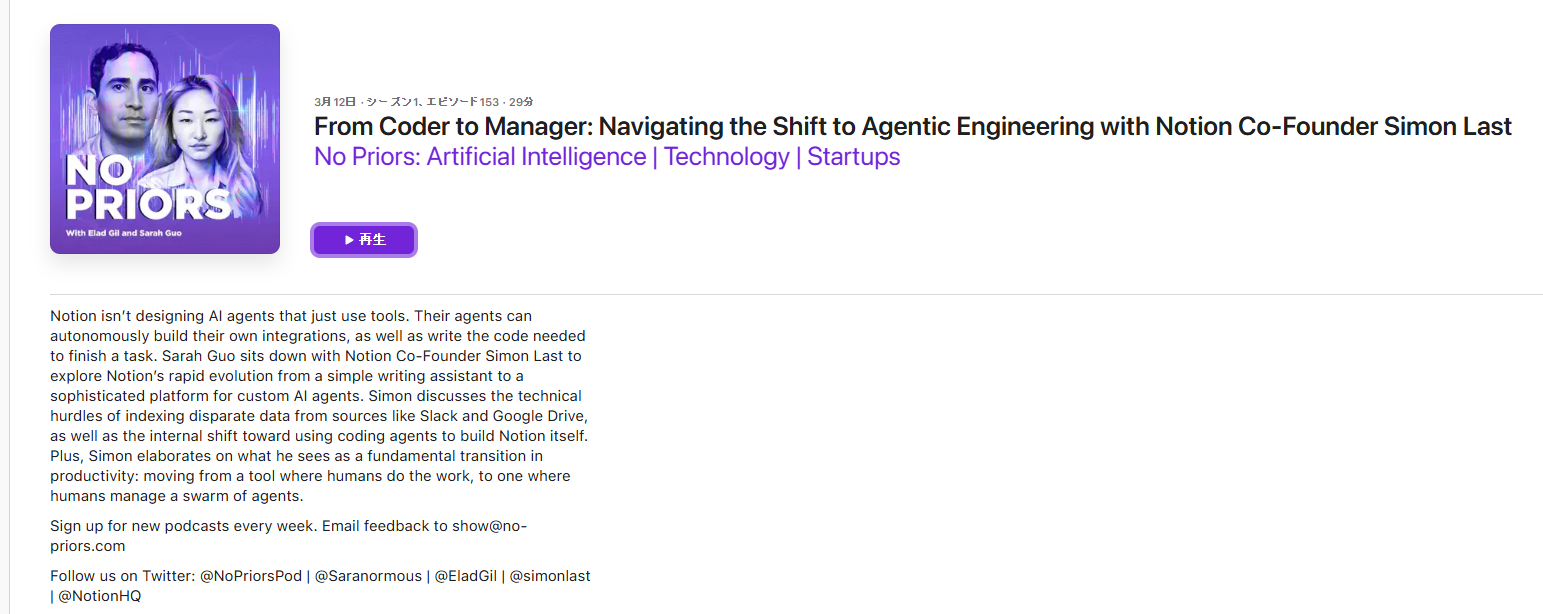

I recently listened to No Priors episode 153 (March 12, 2026) where Simon Last, one of Notion’s founders, talked about how they started using AI in 2022 and how that evolved into long-running agents — one of which ran continuously for 13 days. Below are my hand-typed notes and a quick summary of the key points. Original episode: [https://podcasts.apple.com/jp/podcast/from-coder-to-manager-navigating-the-shift-to-agentic/id1668002688?i=1000754826750].
Two plans
When GPT-4 appeared in 2022, Simon and co-founder Ivan Zhao saw its potential and sketched out two parallel plans: a short-term plan and a long-term plan.
-
Short-term: Use AI to help with writing, rewriting, and content generation.
-
Long-term: Build a general-purpose agent that can create databases, write docs, search, and handle multi-day tasks autonomously.
That short-term feature became Notion AI and launched to all users in February 2023. Initially it handled edits and rewrites without retrieval. The development timeline Simon mentioned:
-
2022: company-wide decision and roadmap set.
-
2023-02: first AI feature launched.
-
2023-10: semantic search released.
-
2025-09: Notion 3.0 with full agent capabilities.
-
2026-02: custom agents that can run autonomously in the background, doing tasks for many days.
RAG-style Q&A and retrieval
Next they built a Q&A / RAG-like feature: semantically index a workspace so AI can answer user questions using those indexed chunks. After launching it, Simon realized they needed to index external sources too — Slack, Google Drive, etc. — because those platforms’ native search is often poor, and Notion could do better.
Simon’s point: “AI doesn’t care what your folder tree looks like; it only cares whether a piece of text contains the information you need.” To support this, Notion uses a chunking strategy: split long documents into chunks for retrieval.
Rewrite the system every six months
The host asked how often they rewrite their AI environment. Simon said roughly every six months — and that the cadence is getting faster as models improve. This is crucial: you can’t build once and forget it. With rapid model progress, you must frequently redesign core systems.
Has AI made work easier?
Simon said yes. Notion adopted Claude Code early (from April 2025) and, by summer 2025, had mostly stopped hand-writing code. Their progression was:
-
Start with Tab completion.
-
Then use AI to insert and rewrite parts of code.
-
Then use Claude Code to analyze the entire codebase end-to-end, implement features, and verify/maintain them.
At that point teams must think seriously about architecture and verification loops: what are you trying to build, how do you validate it, and how do you deploy it safely? When used well, AI enables more ambitious and more robust work; used poorly, it produces garbage.
Agent work inside Notion
Notion built a “Design Playground,” a lightweight Notion instance to help designers prototype quickly. For high-risk code that touches secure data, they still enforce strict code review: every PR requires unit tests. No untested PRs are accepted.
Team impact and productivity
Everyone’s output rose significantly; teams did not shrink because of AI. However, engineers who are good at AI programming gained a much larger productivity advantage. The floor (minimum capability) stayed the same, but those skilled with AI saw orders-of-magnitude increases in output — Simon even suggested enormous multipliers for top practitioners.
By September 2025 Notion’s AI became a full agent able to read and modify workspace content; each user could have a personal agent.
Market layers and model-agnostic design
Simon divides the market into three layers:
-
Labs and model providers
-
Software platforms
-
Infrastructure
Notion positions itself at the platform layer and intentionally stays model-agnostic — it can switch models when needed. Notion also designed a custom API for agents: the default API is JSON, but LLMs prefer Markdown, so they designed agent-facing APIs using carefully crafted Markdown and SQL-like structures that the models handle well.
Always-on agents
Their current aim is to run as many agents as possible, continuously. Every night they queue tasks for agents to run overnight and expect them to still be running the next morning. Examples: feedback-routing agents that monitor Slack for signals, and mail-sorting agents that classify and prioritize emails.
Goal
Notion’s goal is to build the best management agents to do work for humans: agents that organize, surface, and act on information across your apps so people can focus on higher-value tasks.
— End of notes.