
A Realistic Look at Learning, Intelligence, and Human Growth in the AI Era
Artificial intelligence—especially large language models—has reached a point where it’s no longer just a tool. It’s becoming an environment. That shift matters.
We used to think of AI as something we trained. Feed it data, refine outputs, improve accuracy. Straightforward. But something subtle is happening now: the way AI learns is starting to reflect how humans learn—and, in some cases, expose where we don’t.
This feedback loop is easy to miss. Humans shape AI, AI reshapes human behavior, and over time… people start relearning how to learn.
Not entirely intentional. Still happening.
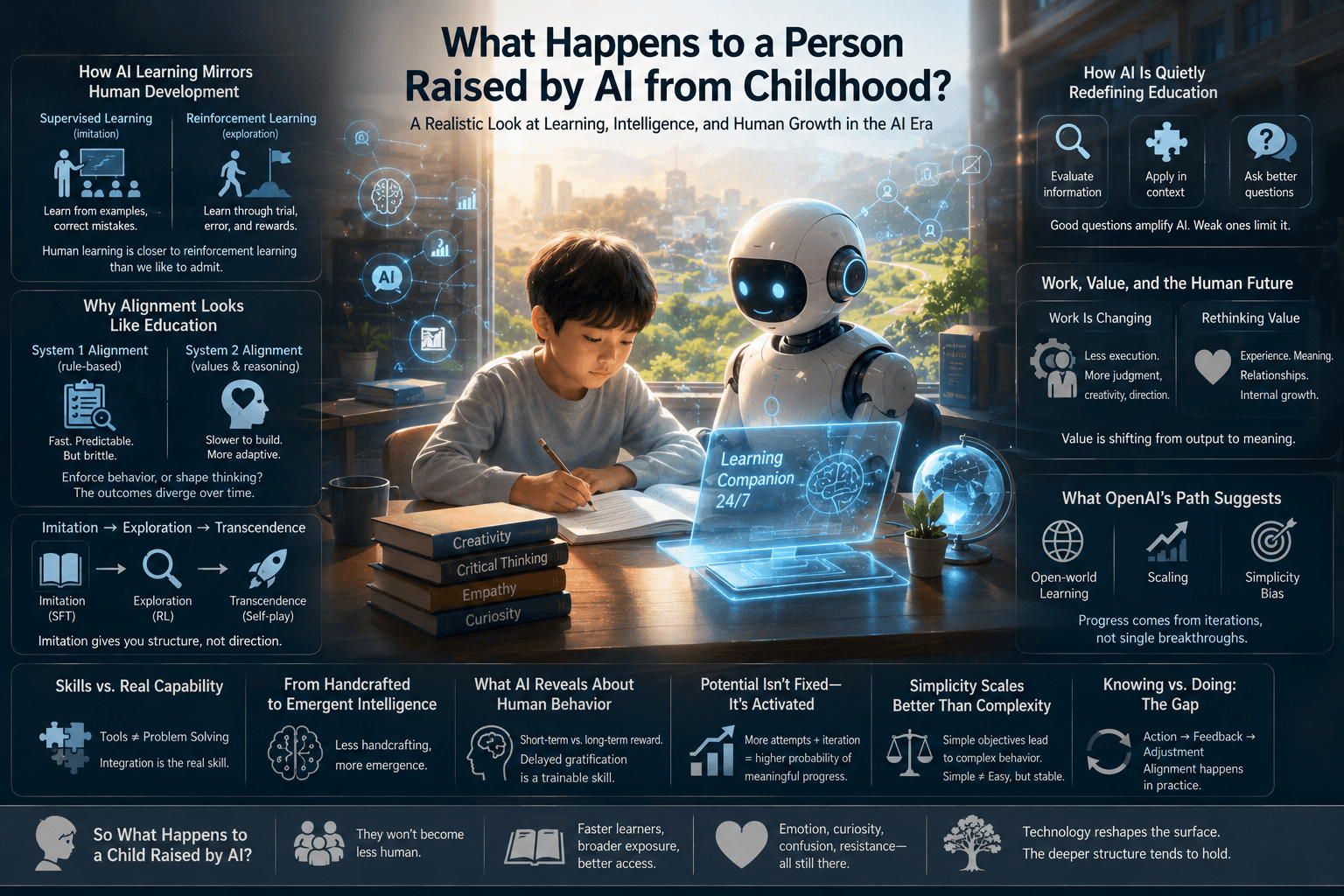
How AI Learning Mirrors Human Development
Supervised learning is often compared to traditional teaching. Show examples, correct mistakes, repeat. It works—up to a point. Narrow tasks, predictable outputs, clean evaluation metrics.
But scale that up? It breaks. You can’t label the entire world.
More importantly, supervised systems don’t really discover anything. They replicate. That’s the ceiling.
Reinforcement learning changes the dynamic. Instead of prescribing every step, you define incentives—rewards, penalties—and let the system explore. Messy process. Unstable at times. But this is where capability expands.
Worth noting: human learning looks much closer to reinforcement learning than we like to admit. Trial, error, adjustment. Occasionally insight.
Why “Alignment” Looks a Lot Like Education
There’s a tendency to treat AI alignment as a purely technical problem. It isn’t. It’s philosophical, behavioral—arguably educational.
System 1 alignment (rule-based, command-driven) produces compliance. Fast. Predictable. Also brittle.
System 2 alignment leans into values, reasoning, internal judgment. Slower to build. Harder to measure. But far more adaptive.
This distinction shows up in parenting, teaching, even management styles. You can enforce behavior, or you can shape thinking. The outcomes diverge over time—sometimes dramatically.
Imitation, Exploration… Then Something Else
Most learning systems—human or artificial—don’t start with originality.
They imitate first.
Then they explore. Try variations. Fail. Adjust.
Eventually, if conditions allow, they go beyond what they were shown.
In machine learning terms, this maps cleanly:
-
Supervised Fine-Tuning (SFT) → imitation
-
Reinforcement Learning (RL) → exploration
-
Self-play / iterative optimization → transcendence
But here’s the catch—imitation gives you structure, not direction. It shows what worked for someone else. Not necessarily what works for you.
That gap matters more than people expect.
Skills vs. Real Capability: The Integration Problem
Knowing how to use tools is not the same as solving problems.
This sounds obvious. It isn’t.
A student can read papers, run experiments, generate charts—and still struggle to complete a full research project. Why? Because integration is a separate skill.
Same with AI.
Single-step tool use (call an API, generate output, retrieve data) handles isolated actions. Useful, but limited.
Chain-of-Action (CoA) systems go further. They link decisions across steps—plan, execute, adjust, repeat. That’s closer to real-world problem solving.
And yes, this is where current AI systems are rapidly improving.
From Handcrafted Logic to Emergent Intelligence
AI didn’t always look like this.
Early systems relied heavily on manual design—features, rules, explicit logic. Then came machine learning, then deep learning, and now reinforcement learning layered on top.
The pattern is consistent: less handcrafting, more emergence.
Even reasoning has shifted. Prompt engineering (like Chain-of-Thought prompting) used to simulate reasoning externally. Now models increasingly generate internal reasoning processes on their own.
Agents push this further. Instead of following fixed workflows, they learn when to act, how to act, and what sequence of actions makes sense.
Not perfectly. But directionally clear.
What AI Reveals About Human Behavior
Reinforcement learning optimizes long-term reward. Humans… often don’t.
Short-term dopamine loops—scrolling, instant feedback, quick wins—are incredibly effective at hijacking attention. Evolutionarily useful, maybe. In modern environments, not always.
Delayed gratification becomes a skill. Not suppression—more like negotiation.
Small rewards, structured incentives, pacing. Aligning emotional impulses with rational goals. This part is subtle but important.
Potential Isn’t Fixed—It’s Activated
Some recent AI systems show strong reasoning ability without heavy supervised training. They improve through exploration alone.
That idea maps uncomfortably well onto human development.
People often underestimate how much ability sits unused—not because it isn’t there, but because it isn’t activated. No feedback loop, no iteration, no sustained effort.
There’s a kind of “scaling law” in life too. More attempts, more exposure, more iteration → higher probability of meaningful progress.
Not guaranteed. But correlated.
Simplicity Scales Better Than Complexity
This one feels counterintuitive.
Simple training objectives—like next-token prediction—lead to surprisingly complex behavior. Language understanding, reasoning, abstraction. Emergent properties.
Overly complex systems, on the other hand, tend to be brittle.
There’s a parallel in human decision-making. Clear goals, simple principles—those tend to outperform overly engineered life plans.
Say it plainly: simple doesn’t mean easy. It means stable.
Knowing vs. Doing: The Gap That Doesn’t Close Itself
A familiar question: why do people understand so much, yet still struggle to live well?
Early AI had the same issue. Strong at language, decent at reasoning—zero real-world execution.
Agent systems change that by introducing environment interaction. Decisions lead to actions, actions produce feedback, feedback reshapes behavior.
That loop—action → feedback → adjustment—is where alignment actually happens.
Not in theory. In practice.
How AI Is Quietly Redefining Education
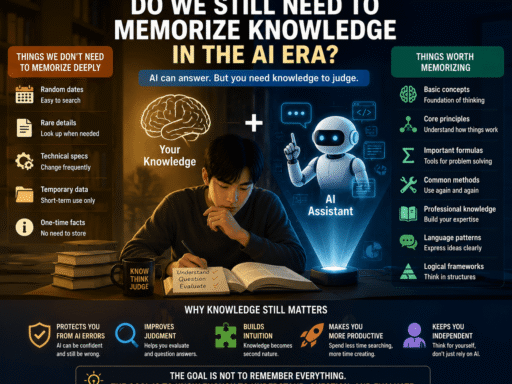
When knowledge is always accessible, memorization loses value.
What replaces it?
-
Evaluating information quality
-
Applying knowledge in context
-
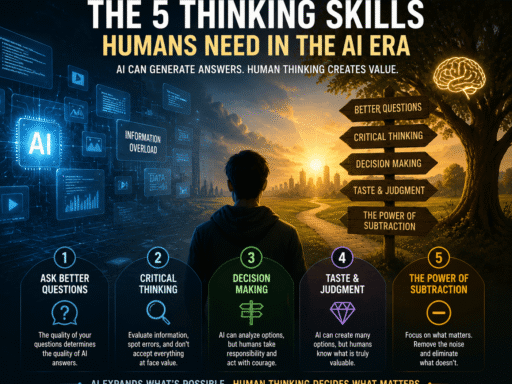
Asking better questions
The last one is underestimated. Good questions amplify AI. Weak questions limit it.
Students who learn how to ask—really ask—will outperform those who simply recall.
Work Is Changing—Whether We Like It or Not
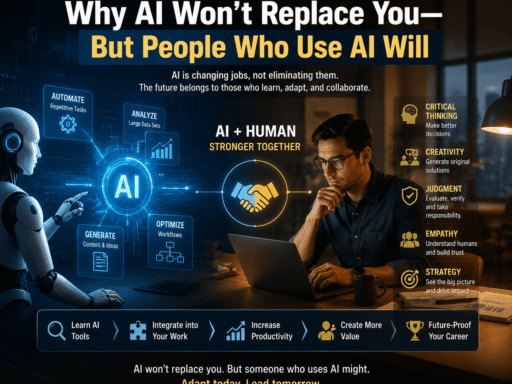
If AI handles repetitive tasks, the role of human work shifts.
Less execution. More judgment, creativity, direction-setting.
Some argue this reduces the importance of work. Maybe. Or maybe it just changes its function.
Historically, work has been tied to identity. That connection may weaken. Not disappear, but loosen.
Rethinking Value in the Age of AI
For a long time, value was tied to output—productivity, economic contribution.
But if AI produces more efficiently than humans in many domains, that metric starts to feel incomplete.
What remains?
Experience. Meaning. Relationships. Internal growth.
Less measurable. More personal.
What OpenAI’s Path Suggests
OpenAI didn’t optimize for narrow benchmarks early on. It aimed at general intelligence—arguably a riskier path.
Two principles stood out:
-
Open-world learning
-
Scaling
Also, a bias toward simplicity. Next-token prediction looks trivial. It isn’t.
Progress didn’t come from a single breakthrough either. It came from iterations—OpenAI Five, Universe, Dactyl, small experiments that later became foundational.
Even the GPT lineage traces back to relatively modest beginnings.
So What Happens to a Child Raised by AI?
Probably not what people fear.
They won’t become less human. If anything, they may become more capable—faster learners, broader exposure, better access to knowledge.
But the core human traits don’t disappear.
Emotion, curiosity, confusion, resistance, identity—all still there.
Technology reshapes the surface. The deeper structure… tends to hold, at least for now.
I’m not sure exactly why but this blog is loading incredibly slow for me. Is anyone else having this problem or is it a issue on my end? I’ll check back later on and see if the problem still exists.