
1. A Consultant’s “10-Year Prediction” Reality Check
Not long ago, after visiting several companies, a CEO asked me:
“AI is everywhere right now. Is it a real turning point or just another bubble? Ten years from now, will it become infrastructure like electricity or the internet?”
Honestly, I think the question itself is flawed—not because it’s unimportant, but because it’s framed incorrectly.
That said, I completely understand the anxiety behind it. Over the past year and a half, I’ve worked with more than 200 companies. Nine out of ten are struggling with the same question:
Is AI worth going all-in on?
I told him a true story.
Back in 2016, when I was at Stanford, deep learning had just made breakthroughs on ImageNet. Silicon Valley was full of slogans like “AI will change the world.” In one AI startup class, a professor confidently said:
“Within five years, AI will make half of programmers unemployed.”
Nine years later, programmers are still here—and earning more than ever.
Yes, AI is powerful in certain areas. It can find your cat in millions of photos. But it still can’t reliably fix a messy PowerPoint based on your boss’s vague feedback.
That experience stayed with me.
After working with hundreds of companies and reviewing countless industry reports, I’ve come to a clearer conclusion:
AI is neither the “near-term singularity” imagined by enthusiasts nor “just another blockchain” as skeptics claim.
It is taking a third path:
Like electricity—slowly spreading, imperfectly implemented, occasionally impressive, often unremarkable, but ultimately transformative.
Electricity took nearly 60 years to reach widespread household adoption.
The internet took about 30 years to connect half the world.
AI? It has only been about a decade since AlexNet (2012).
We are judging its final outcome far too early.
2. Reality Check: Where AI Stands Today
Let’s start with data.
-
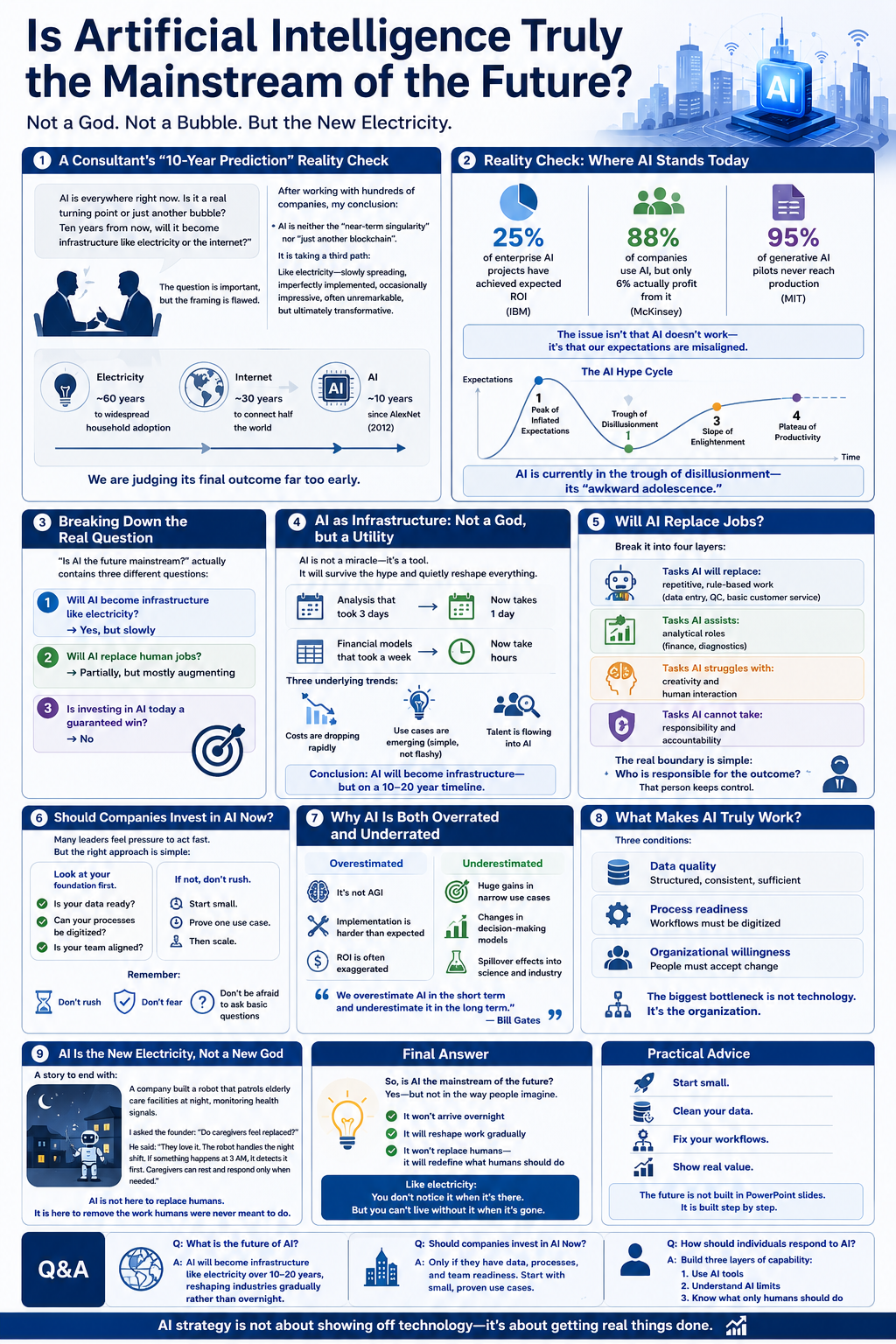
Only about 25% of enterprise AI projects have achieved expected ROI (IBM)
-
88% of companies use AI, but only 6% actually profit from it (McKinsey)
-
95% of generative AI pilots never reach production (MIT)
What does this mean?
The issue isn’t that AI doesn’t work—it’s that our expectations are misaligned.
Every technology follows a “hype cycle”:
-
Peak of inflated expectations
-
Trough of disillusionment
-
Slope of enlightenment
Where is AI now?
Past the hype peak, currently in the trough, and still a few years away from maturity.
I call this stage:
“AI’s awkward adolescence” — promising, but not yet reliable.
3. Breaking Down the Real Question
“Is AI the future mainstream?” actually contains three different questions:
-
Will AI become infrastructure like electricity? → Yes, but slowly
-
Will AI replace human jobs? → Partially, but mostly augmenting
-
Is investing in AI today a guaranteed win? → No
Let’s unpack them.
4. AI as Infrastructure: Not a God, but a Utility
AI is not a miracle—it’s a tool.
Like the internet after the dot-com bubble, it will survive the hype and quietly reshape everything.
From my consulting experience:
AI doesn’t replace people overnight—it improves productivity step by step.
-
Analysis that took 3 days now takes 1
-
Financial models that took a week now take hours
This is how real transformation happens: slowly, unevenly, but persistently.
Three underlying trends:
-
Costs are dropping rapidly
-
Use cases are emerging (often simple, not flashy)
-
Talent is flowing into AI
Conclusion:
AI will become infrastructure—but on a 10–20 year timeline.
5. Will AI Replace Jobs?
Break it into four layers:
-
Tasks AI will replace: repetitive, rule-based work (data entry, QC, basic customer service)
-
Tasks AI assists: analytical roles (finance, diagnostics)
-
Tasks AI struggles with: creativity and human interaction
-
Tasks AI cannot take: responsibility and accountability
The real boundary is simple:
Who is responsible for the outcome?
That person keeps control.
6. Should Companies Invest in AI Now?
Many leaders feel pressure to act fast.
But the right approach is simple:
Look at your foundation first.
Ask three questions:
-
Is your data ready?
-
Can your processes be digitized?
-
Is your team aligned?
If not, don’t rush.
Instead:
Start small. Prove one use case. Then scale.
Remember:
-
Don’t rush
-
Don’t fear
-
Don’t be afraid to ask basic questions
7. Why AI Is Both Overrated and Underrated
As Bill Gates said:
“We overestimate AI in the short term and underestimate it in the long term.”
Overestimated:
-
It’s not AGI
-
Implementation is harder than expected
-
ROI is often exaggerated
Underestimated:
-
Huge gains in narrow use cases
-
Changes in decision-making models
-
Spillover effects into science and industry
8. What Makes AI Truly Work?
Three conditions:
-
Data quality — structured, consistent, sufficient
-
Process readiness — workflows must be digitized
-
Organizational willingness — people must accept change
The biggest bottleneck is not technology.
It’s the organization.
9. AI Is the New Electricity, Not a New God
A story to end with:
A company built a robot that patrols elderly care facilities at night, monitoring health signals.
I asked the founder:
“Do caregivers feel replaced?”
He said:
“They love it. The robot handles the night shift. If something happens at 3 AM, it detects it first. Caregivers can rest and respond only when needed.”
That changed how I see AI.
AI is not here to replace humans.
It is here to remove the work humans were never meant to do.
Final Answer
So, is AI the mainstream of the future?
Yes—but not in the way people imagine.
-
It won’t arrive overnight
-
It will reshape work gradually
-
It won’t replace humans—it will redefine what humans should do
Like electricity:
You don’t notice it when it’s there.
But you can’t live without it when it’s gone.
Practical Advice
Start small.
-
Clean your data
-
Fix your workflows
-
Show real value
The future is not built in PowerPoint slides.
It is built step by step.
Q&A
Q: What is the future of AI?
A: AI will become infrastructure like electricity over 10–20 years, reshaping industries gradually rather than overnight.
Q: Should companies invest in AI now?
A: Only if they have data, processes, and team readiness. Start with small, proven use cases.
Q: How should individuals respond to AI?
A: Build three layers of capability:
-
Use AI tools
-
Understand AI limits
-
Know what only humans should do
AI strategy is not about showing off technology—it’s about getting real things done.