

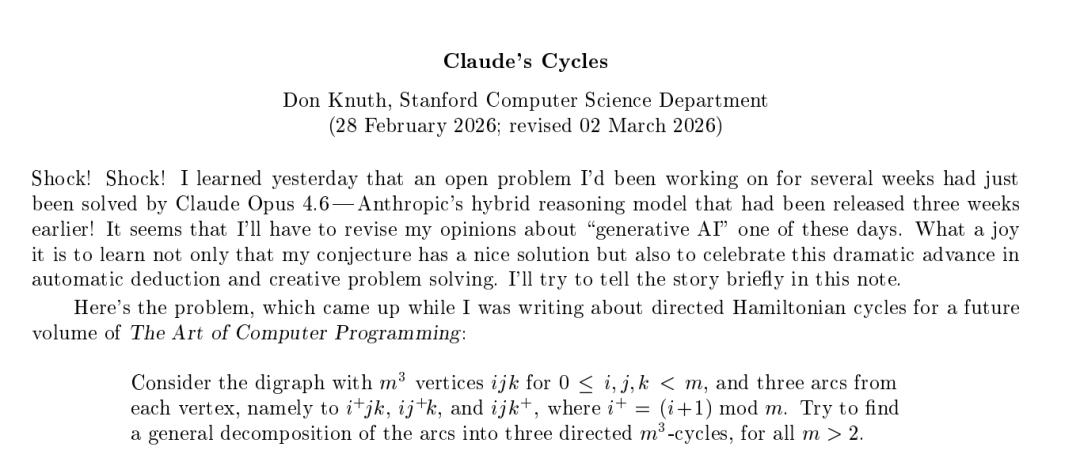
Donald Knuth, the legendary computer scientist who wrote The Art of Computer Programming, just published a paper that starts with two words: “Shock! Shock!” What made the 88-year-old Turing Award winner so surprised? An AI model named Claude Opus 4.6 solved a math problem that had stumped him for weeks. And it did this in just 31 steps.
This is not just another AI news story. This is a real turning point in how we think about artificial intelligence and mathematics. Let me explain what happened, why it matters, and what it means for the future of research.
Who Is Donald Knuth and Why Should You Care
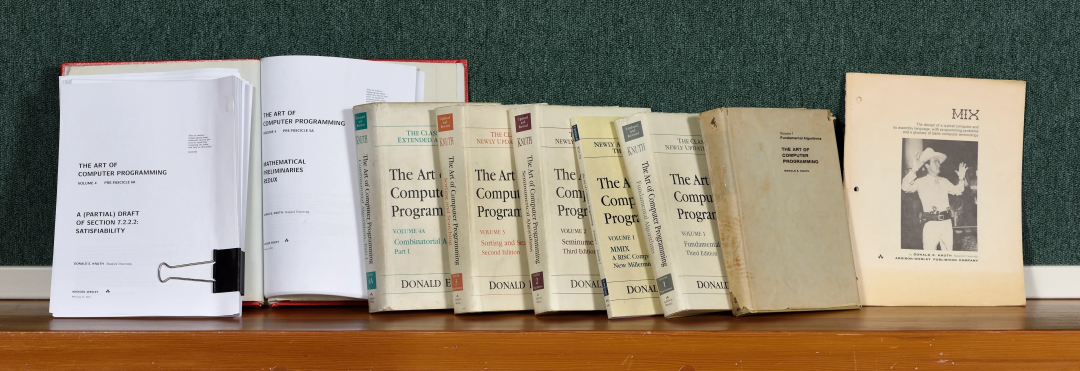
Donald Knuth is often called the father of algorithms. He created the TeX typesetting system that scientists use every day. His book series The Art of Computer Programming has been called the most important computer science project ever started. When someone who has spent 50 years writing about algorithms says he needs to change his mind about AI, the world should pay attention.
Knuth is famous for being careful with praise. He once offered $2.56 to anyone who found an error in his books. That is exactly 256 pennies, or one “hexadecimal dollar.” So when he writes “Shock! Shock!” at the start of a paper, you know something truly unexpected has happened.
The Problem That Stumped a Genius

The problem sounds simple but hides deep complexity. Imagine a 3D grid shaped like an m by m by m cube. Each point in this cube has three coordinates (i, j, k), and each number ranges from 0 to m-1. This gives you m-cubed total points.
From every point, you can move in three directions: increase i by 1, increase j by 1, or increase k by 1. When you reach the edge, you wrap around to the start. Think of it like a 3D version of Pac-Man, where going off one side brings you back on the other.
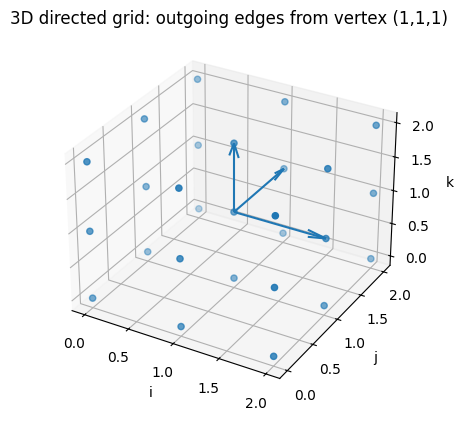
A Hamiltonian cycle is a path that visits every point exactly once and then returns to where it started. Knuth wanted to find three separate Hamiltonian cycles that together cover every single edge in the grid. No edge could be used twice. No point could be skipped.
Why is this hard? At every single point, you must choose one of three directions. With m-cubed points, the number of possible choices grows to 3 raised to the power of m-cubed. That number is so large that no computer can check every option, even for small values of m.
Knuth had solved the case where m equals 3. His friend Filip Stappers found solutions by computer for values up to 16. But nobody knew if a general rule existed that would work for all odd numbers greater than 2.
How Claude Opus 4.6 Cracked the Code
Filip Stappers gave the problem to Claude Opus 4.6, a hybrid reasoning model made by Anthropic. He set one strict rule: after every exploration, Claude had to write down what it learned before starting the next one. This forced the AI to think step by step, just like a human researcher keeping a lab notebook.
Claude did not guess the answer in one flash of insight. It went through 31 separate explorations over about one hour. The process looked remarkably like how a graduate student would attack a hard problem.

First, Claude tried simple math formulas. It wanted to find a function that would tell each point which direction to go. Linear formulas failed quickly. Then it tried brute force search, but the search space was too large even for a powerful AI.
Next, Claude studied the 2D version of the problem. It found a “snake-like” pattern that worked in two dimensions. It tried to extend this idea to three dimensions using something similar to a Gray code pattern. This gave partial progress but could not solve the full problem.
For the next several attempts, Claude kept hitting walls. It tried simulated annealing, a technique that uses randomness to escape dead ends. It tried backtracking search. These methods found specific solutions but revealed no general pattern.
The Key Breakthrough: Fiber Decomposition

At exploration 15, Claude made a crucial observation. It defined a value s equal to (i + j + k) mod m. Every move in the grid changes s to s+1. This means the entire 3D space can be split into layers based on the value of s.
Think of it like slicing an onion. Each slice is a 2D grid, and moving between slices follows a simple rule. This “fiber decomposition” turned a hard 3D problem into a stack of easier 2D problems.
Even clothing remover ai with this insight, Claude still needed more work. It tried random searches within each layer. It tested many patterns. But the general rule stayed hidden.
The 31st Exploration: The Solution Appears
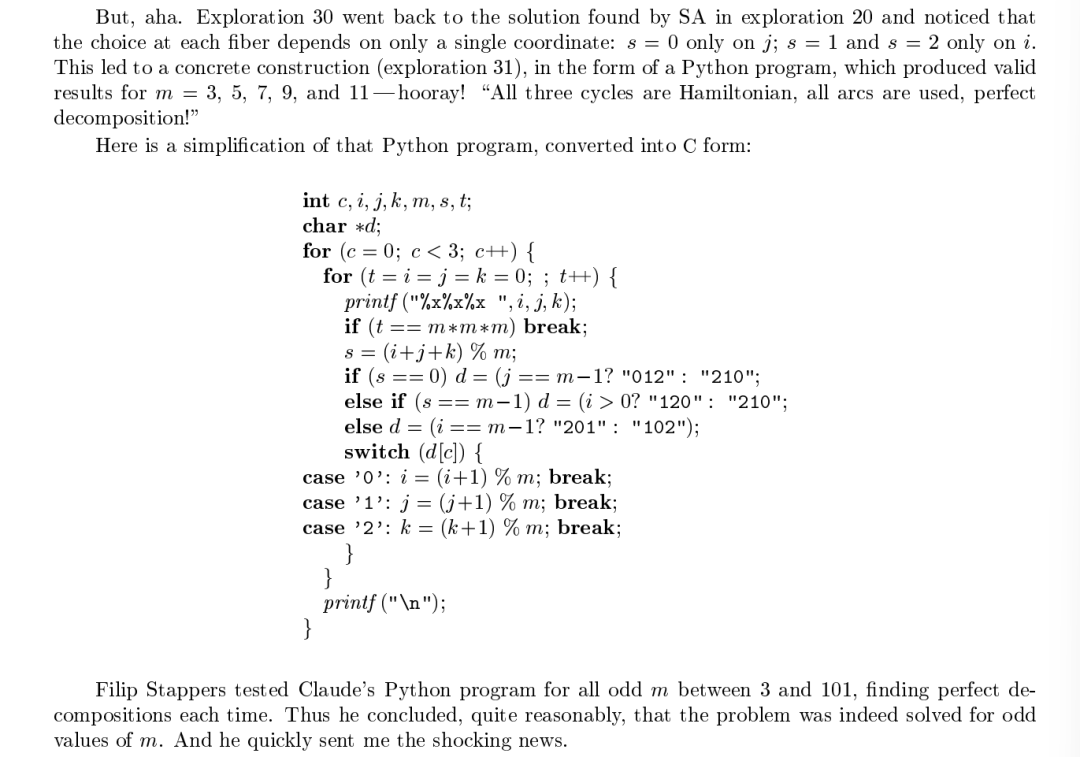
At the 31st exploration, Claude finally saw the pattern. It kept the fiber decomposition idea but added a simple rule for choosing directions. The cuck chat rule depends on which layer you are in:
If s equals 0, the direction depends on the value of j.
If s is between 0 and m-1, the direction depends on the value of i.
If s equals m-1, a special rule applies.
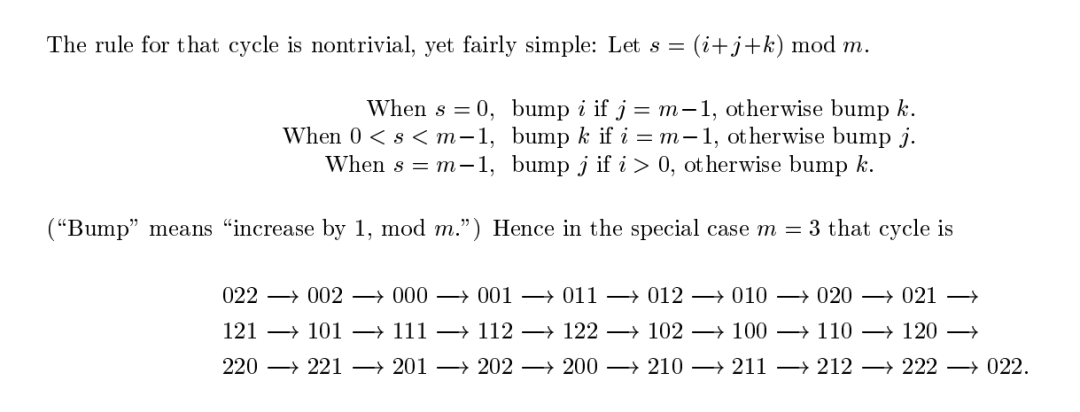
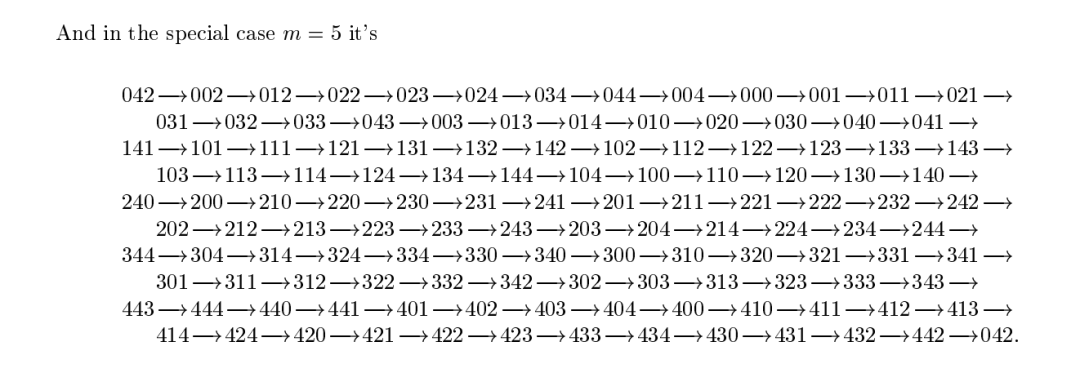
Claude wrote a short Python program to test this rule. It worked for m equals 3, 5, 7, 9, and 11. All three paths were valid Hamiltonian cycles. Every edge was used exactly once.
ai nude generator
Knuth was amazed. He wrote in his paper that this was “really impressive” when he saw the third exploration step. For a man who rarely gives compliments, this was high praise indeed.
Knuth Proves It: From AI Guess to Mathematical Truth
Claude found the construction, but construction alone is not a proof. Knuth took over and provided the rigorous mathematical proof that mathematicians require.
He showed that Claude’s path visits all m-squared points with the same i value before moving to the next i value. The path covers every point exactly once and returns to the start after m-cubed steps. The same logic applies to the other two cycles, completing the proof.
Knuth also discovered something remarkable. Claude’s solution is not unique. There are 760 similar decompositions that share the same basic structure. Claude found just one of many valid answers.
However, Claude only solved the problem for odd values of m. When m is even, the problem behaves differently. Researchers have already proved that no solution exists for m equals 2. The even case remains partly open, though other AI models have made progress on it since.
Why This Changes Everything
The most important part of this story is not the solution itself. It is how Claude reached the solution.
Claude did not guess randomly. It rephrased the problem, wrote programs, tested ideas, failed, adjusted, and tried again. This process looks exactly like how human mathematicians work.
For decades, people believed that mathematical proof was the last area where AI could not compete. Math requires creativity, structure, and deep insight. Statistical pattern matching was thought to be too shallow for real mathematics.
This paper proves that belief wrong. AI can now participate in genuine mathematical exploration. It can suggest structures that humans then verify and formalize.
Knuth himself admits he must change his views on generative AI. If the most careful and respected mind in computer science is revising his opinion, then the rest of us should pay close attention.
A New Research Model Is Born

We may be seeing the birth of a new way to do research. Humans pose the questions. AI explores the space of possible structures. Humans verify the results and provide formal proofs. This hybrid model could speed up discovery in mathematics, physics, and computer science.
The paper is titled “Claude’s Cycles.” It will live forever as part of Knuth’s legendary book series. For the first time, an AI has earned its place in the history of mathematical thought.
Knuth has spent more than half a century writing The Art of Computer Programming. That series documents how human algorithmic thinking has evolved. Now AI appears in the paper of the algorithm master himself. This is not the end of human mathematics. It is the beginning of a partnership.
What comes next? Other researchers have already extended this work. One team used formal proof assistants to verify the result in the Lean system. Another group used different AI models to attack the even-number case. The race is on, and it is a race between humans and machines working together.
Knuth ended his paper with a simple request: stop writing to him about this. He has a book to finish. Even at 88, the master keeps working. And now he has a new tool to help him.
What This Means for You
If you work in technology, this story matters. It shows that AI is moving beyond simple tasks into creative problem solving. The tools you use today will be more powerful tomorrow. The skills you need will change.
Learning to work with AI, rather than against it, is becoming essential. The future belongs to people who can ask good questions and verify good answers. Claude found the structure, but Knuth provided the proof. Both were necessary.
The age of AI mathematics has begun. And it started with a simple message from an 88-year-old genius: Shock! Shock!