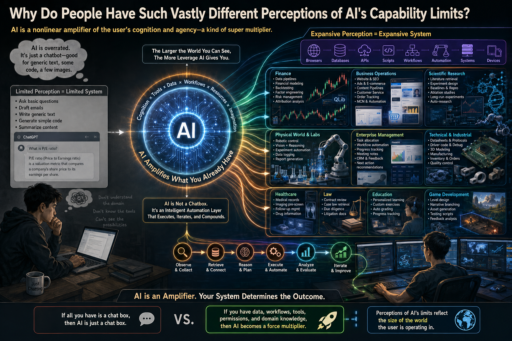
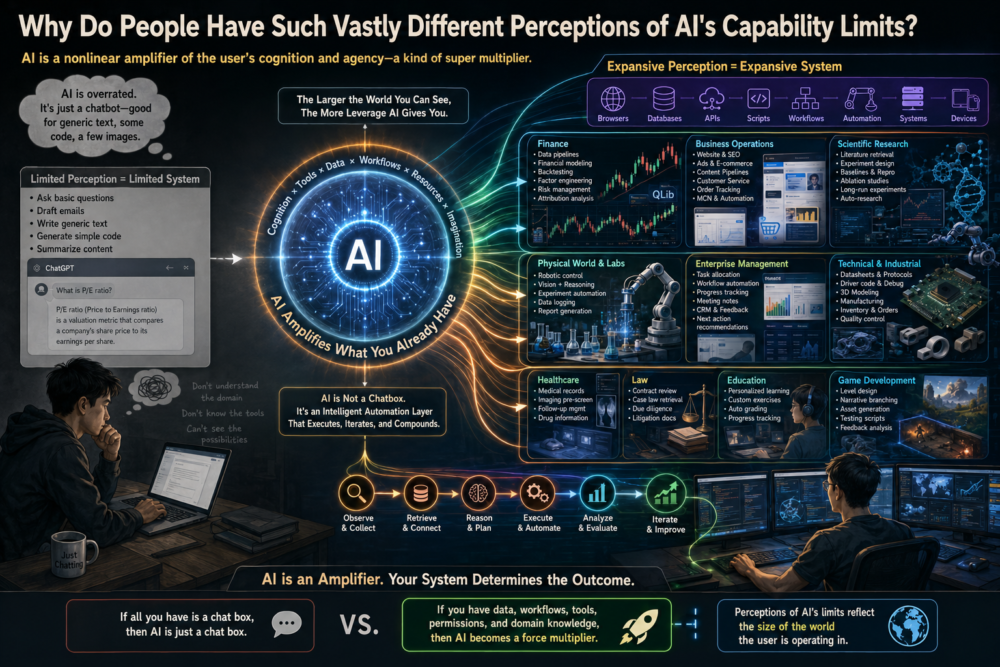

AI is not, at its core, just an isolated “chatbot.” It is a nonlinear amplifier of the user’s cognition and agency—a kind of super multiplier.
It doesn’t simply raise everyone’s abilities by the same margin. Instead, it amplifies whatever you already have: your knowledge structure, industry experience, tool proficiency, execution resources, and imagination.
In other words, the larger the world you can already see, the more leverage AI gives you. If you don’t even know a certain domain exists, AI alone can’t magically make you understand the opportunities within it.
This is why perceptions of AI vary so dramatically. Some people believe AGI is just around the corner, even that tools like GPT can already handle a large portion of white-collar work. Others feel AI is overrated—good for writing generic text, generating some code, or producing a few images, but not much more.
Both perspectives are partially true. The difference lies in the “system” each person plugs AI into.
If someone only uses AI to ask basic questions or draft emails, it will naturally feel useful but limited. But if another person integrates AI into browsers, databases, scripts, APIs, automated workflows, enterprise systems, trading systems, experimental pipelines, or even production equipment, then what they see is no longer a chat interface—it’s an intelligent automation layer that can continuously call tools, execute tasks, and compound improvements over time.
Take finance as an example.
If someone doesn’t invest, doesn’t read platforms like Seeking Alpha, doesn’t use APIs like Yahoo Finance or EDGAR, and doesn’t understand financial modeling, backtesting, factor engineering, or risk management, it’s hard for them to imagine how AI could participate in investment decisions. To them, AI might just explain what a P/E ratio is or summarize market news.
But for someone who already understands data pipelines, backtesting frameworks, and trading logic, AI becomes far more powerful. It can screen assets, parse financial statements, generate strategies, write scrapers, build backtests, and perform attribution analysis. Combined with tools like Qlib, it can rapidly iterate research workflows.
The key question is not whether AI can “make money,” but whether the user understands which parts of finance are automatable, modelable, and suitable for large-scale experimentation.
The same applies to business operations.
If someone doesn’t understand frontend/backend development, website deployment, SEO, paid advertising, e-commerce fulfillment, or social media operations, then concepts like “AI-powered global expansion,” “automated independent stores,” or “content monetization pipelines” remain abstract. They see AI as a copywriting tool.
But someone who understands the business sees an entire chain: product selection, site building, landing pages, creative generation, ad testing, customer service, order tracking, and iterative optimization.
Take it one step further—someone with an MCN (multi-channel network) mindset will realize that AI isn’t just writing scripts. Combined with browser automation, account matrices, video uploading, and data monitoring, AI can take over a large portion of content production and distribution.
Tools like Browserbase, Browser Use, and OpenCLI are already making AI-controlled browsers a reality. Filling forms, logging into dashboards, scraping gated content, uploading videos, and booking services are no longer theoretical. But this only works if you understand how to connect MCP (Model Context Protocol), skills, permissions, scripts, and execution environments.
The same pattern holds in scientific research.
To a non-researcher, AI-generated literature reviews may seem like simple summaries. But for actual researchers, AI can become a full workflow accelerator. By combining APIs like Semantic Scholar, Google Scholar scraping, GitHub MCP, Docker-based environments, experiment logs, and scheduled execution harnesses, AI can assist with literature retrieval, related work synthesis, experiment reproduction, baseline implementation, dependency debugging, and ablation study design.
It can even run dozens of experiment variations continuously—for example, using tools like Claude in long-running modes. (Think of Karpathy’s “auto-research” direction.)
Moving into the physical world, AI doesn’t stop at text and code. Systems like Codex or similar tools, when combined with vision modules, reasoning chains, and action policy models, can control robotic arms to perform structured experimental procedures.
In fields like physics, chemistry, and biology—where workflows are relatively standardized—automatic logging, retrieval, comparison, and report generation are already feasible. With speech recognition, experiment logs, and RAG (retrieval-augmented generation), researchers can even record observations hands-free and have them automatically structured and indexed.
In enterprise management, the gap is just as clear.
If someone doesn’t understand how organizations actually operate—task allocation, kanban systems, workflow automation in tools like Feishu or DingTalk, team collaboration, sync meetings, performance tracking, or CRM systems—it’s hard to imagine AI playing a meaningful role.
They might use AI to write weekly reports. But someone else will use it to aggregate project status, break down tasks, track delays, generate meeting notes, notify stakeholders, analyze customer feedback, and recommend next actions.
Here, AI doesn’t replace the manager—it amplifies their visibility, responsiveness, and control over the organization.
The gap becomes even more obvious in technical and industrial domains.
Take embedded systems as an example. Without experience, one may not even realize how complex datasheets, communication protocols, and hardware adaptation can be. AI can significantly reduce this burden—reading datasheets, explaining parameters, generating driver code, debugging protocols, and handling inconsistencies across vendors.
Or consider 3D modeling and manufacturing. If you’ve never used tools like CadQuery or OpenSCAD, you might not realize that AI can translate natural language into parametric models. Combined with 3D printing, this enables rapid transformation from idea to physical object.
Extend that further—combine it with print farms, inventory systems, order management, and quality control—and AI can semi-automate an entire small-scale manufacturing business.
The same logic applies across industries:
In healthcare, AI enables medical record summarization, imaging pre-screening, follow-up management, and drug information retrieval.
In law, it enables contract review, case law retrieval (extremely valuable), due diligence checklists, and litigation document preparation.
In education, it enables personalized curricula, customized exercises, automated grading, and progress tracking.
In game development, it enables level design, narrative branching, asset generation, testing scripts, and player feedback analysis.
Every industry is filled with structured work that outsiders don’t see and insiders find tedious. That is exactly where AI’s value multiplies.
Ultimately, differences in how people perceive AI’s capabilities are not really about the model itself. They reflect differences in cognitive scope, industry knowledge, and tool ecosystems.
AI is not a uniform capability distributed equally to everyone. It is an amplifier attached to each person’s existing system.
If all you have is a chat box, then AI is just a chat box.
If you have data sources, workflows, engineering tools, automation permissions, and domain knowledge, then AI becomes an execution layer capable of reshaping how work gets done.
So whether AI feels “overhyped” or “already incredibly powerful” often says less about the technology—and more about the size of the world the user is operating in.